Why Autonomous Vehicles Are the Ultimate Physical AI Challenge
For years, AI has largely lived in the digital world—powering chatbots, recommendation engines, and copilots that operate relatively safely behind screens.
Autonomous vehicles have changed that equation entirely.
Perhaps the most ambitious examples of Physical AI, driverless cars are basically mobile data centers that must perceive, interpret, and respond to dynamic environments in real time: pedestrians crossing unexpectedly, cyclists appearing in blind spots, or sudden weather conditions that obscure sensors.
In this environment, AI doesn’t just generate output—it controls machines.
And that raises the stakes dramatically.
Because when Physical AI fails, the consequences are not digital—they’re physical.
Delivering reliable autonomous driving therefore requires far more than sophisticated models. It requires an entirely new class of data infrastructure capable of supporting AI systems operating continuously in the real world.
The Future of Driverless Mobility is Data
Autonomous vehicles rely on a dense array of sensors to understand their surroundings.
Typical sensor stacks include:
- High-resolution cameras
- LiDAR systems producing detailed 3D maps
- Radar and ultrasonic sensors
- GPS and inertial measurement systems
- Internal vehicle telemetry
Together, these sensors create a real-time digital representation of the world around the vehicle. The amount of data generated is staggering. Estimates suggest that a single autonomous vehicle can generate around 4 TB of data per day, depending on configuration and driving conditions. Some projections place the total even higher when accounting for multiple sensors and high-frequency telemetry streams.
“In the AI world, vector databases and checkpoints are essential, as data is queried from multiple angles, forcing significantly more writes than traditional storage systems. This write ratio shift necessitates new performance profiles for training environments.”
– Shawn Rosermarin, Vice President, R&D, at Everpure – from AI and its Impact on Data Storage
Multiply that across fleets of thousands—or tens of thousands—of vehicles and the result is one of the largest distributed data-generation systems ever created. Autonomous vehicles aren’t simply software platforms: they’re mobile AI data pipelines.
The Autonomous Vehicle AI Data Pipeline
Behind every autonomous vehicle is a massive data ecosystem that supports continuous learning and model improvement. This pipeline typically includes three major stages.
1. Edge AI: Real-Time Inference in the Vehicle
The first layer of intelligence lives inside the vehicle itself.
Here, specialized compute platforms run AI models that interpret sensor data and make driving decisions in milliseconds. These systems must detect objects, classify road conditions, and determine safe maneuvers in real time.
Latency is critical. Decisions must happen instantly—often within tens of milliseconds.
This is Physical AI operating at the edge.
“Delivering governed, trustworthy AI now depends on replacing storage management with something more fundamental: managing datasets as first-class infrastructure.”
– Chadd Kenney, VP of Product Management at Everpure, from How Managing Datasets Instead of Storage is Becoming the Deciding Factor for AI Success
2. Fleet Data Collection: Learning from the Real World
Autonomous vehicles are constantly collecting driving data across a wide range of environments—urban streets, highways, construction zones, and extreme weather.
Edge cases captured by vehicles become valuable training data.
Rare scenarios—unexpected obstacles, unusual traffic patterns, or complex intersections—are uploaded to centralized environments where engineers and AI systems analyze them.
At scale, this produces massive, continuously growing datasets that must be indexed, curated, and made accessible for AI development.
3. Model Training and Simulation
The most compute-intensive workloads happen in centralized environments where models are retrained using real-world driving data.
These environments typically include:
- Large GPU clusters
- Massive training datasets
- Simulation environments for digital driving scenarios
- Continuous testing pipelines
Training perception and planning models requires extremely high-throughput access to petabyte-scale datasets.
Which brings us to a crucial point.
The biggest challenge for autonomous vehicles probably isn’t AI algorithms, it’s data infrastructure.
Autonomous Driving Requires an AI Data Factory
Autonomous driving programs increasingly resemble what many organizations are now building for enterprise AI: an AI Data Factory.
An AI Data Factory is an infrastructure architecture designed to continuously ingest, process, store, and feed massive datasets into AI training and inference pipelines.
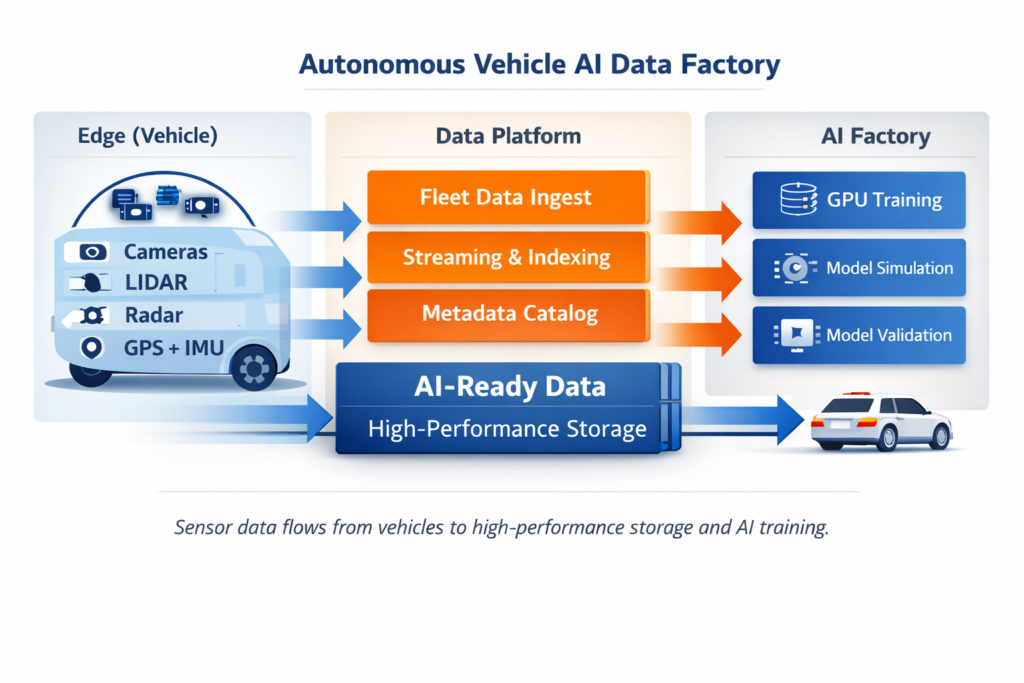
It creates a virtuous cycle:
- Vehicles generate real-world data
- Data is ingested and curated
- Models are trained and validated
- Updated models are deployed back to vehicles
Then the cycle begins again.
The more data the system processes, the more capable the AI becomes.
At scale, this continuous feedback loop becomes the engine driving AI innovation.
This is exactly the model emerging in autonomous driving, and it requires infrastructure capable of supporting massive ingest rates, high-throughput AI pipelines, and continuous data lifecycle management.
Achieving this depends on fast, resilient, and simple-to-manage storage architectures that can keep pace with continuous ingest and training demands—something only modern, all-flash data platforms can deliver.
Why Data Infrastructure Will Determine AV Success
Autonomous vehicle programs are often framed as software challenges, but in reality, theyre data challenges at planetary scale.
Organizations building autonomous systems must solve several fundamental infrastructure problems:
1. Massive Data Ingestion
Sensor data from fleets must be ingested continuously without slowing down AI development pipelines.
2. High-Throughput AI Training
Training perception models requires extremely fast access to massive datasets. Storage performance directly impacts how quickly models can iterate and improve.
3. Continuous Data Readiness
Preparing training datasets—labeling, curating, indexing, and transforming them—often consumes the majority of AI development time.
Modern AI infrastructure must automate these steps so data becomes AI-ready by design, not through manual preparation.
Platforms designed to accelerate data pipelines between storage and GPU clusters can dramatically reduce this bottleneck, helping AI teams move faster from raw data to trained models.
High-throughput model training requires consistent, predictable performance—without adding complexity or cost. Modern flash storage delivers that consistency while optimizing for efficiency and sustainability.
Autonomous Vehicles Are the Leading Edge of Physical AI
Autonomous vehicles represent one of the most demanding applications of AI ever attempted.
But they are not unique.
Across industries—from robotics and manufacturing to logistics, energy, and healthcare—Physical AI systems are emerging that connect models to machines operating in the real world.
These systems share several characteristics:
- Massive sensor-generated datasets
- Continuous feedback loops between edge and centralized training environments
- High-performance compute clusters for model training
- Infrastructure capable of moving and managing enormous volumes of data
In other words, they all require AI data factories.
The Road Ahead
Autonomous vehicles may be one of the most visible examples of Physical AI—but the architectural lessons extend far beyond transportation.
As AI systems move from digital assistants to physical systems interacting with the real world, the underlying data infrastructure becomes just as important as the models themselves.
Organizations that build the right AI data foundation today—capable of ingesting, processing, and feeding data into continuous AI pipelines—will be the ones that lead the next generation of intelligent systems.
Because in the era of Physical AI, success will not just be defined by algorithms.
It will be defined by how effectively organizations turn data into intelligence at scale.And that is exactly what the AI data factory is designed to do.