Purity ActiveDR™ for Oracle Disaster Recovery
Oracle disaster recovery designs are usually driven by two operational requirements: minimizing data loss and making recovery procedures repeatable under pressure.
RMAN, Oracle Data Guard, and site-level infrastructure controls all play important roles, but storage replication remains a foundational part of many DR architectures because it protects the full database footprint at the volume level.
For organizations that require zero RPO and zero RTO business continuity, synchronous replication technologies such as Everpure ActiveCluster can support a metro-style architecture between FlashArray systems, provided network latency is low enough to meet application requirements.
In many Oracle environments, however, the business target is near-zero RPO with flexible distance between sites, which makes asynchronous replication the more practical design point.
With Everpure ActiveDR, Oracle runs on a primary FlashArray while a secondary array at the DR site receives a continuous stream of changes over a dedicated replication network (see Figure 1). This lets teams place DR capacity at the right distance without the latency constraints of synchronous replication.
Figure 1. Example primary‑to‑DR FlashArray topology for Oracle using ActiveDR continuous replication across sites.
Most vendors force you to choose: minutes of data loss, or a distance-limited sync link. ActiveDR removes that trade-off — continuous replication with near-zero RPO, distance-independent, with no impact to production performance. And unlike a bolt-on DR product, it protects your entire DR posture (snapshots, schedules, configs) — not just your data.
What ActiveDR Changes Operationally
The unit of replication in ActiveDR is a pod, which acts as a logical container for volumes, protection groups, and snapshot history, making it straightforward to replicate the full Oracle database footprint between sites (see Figure 2).
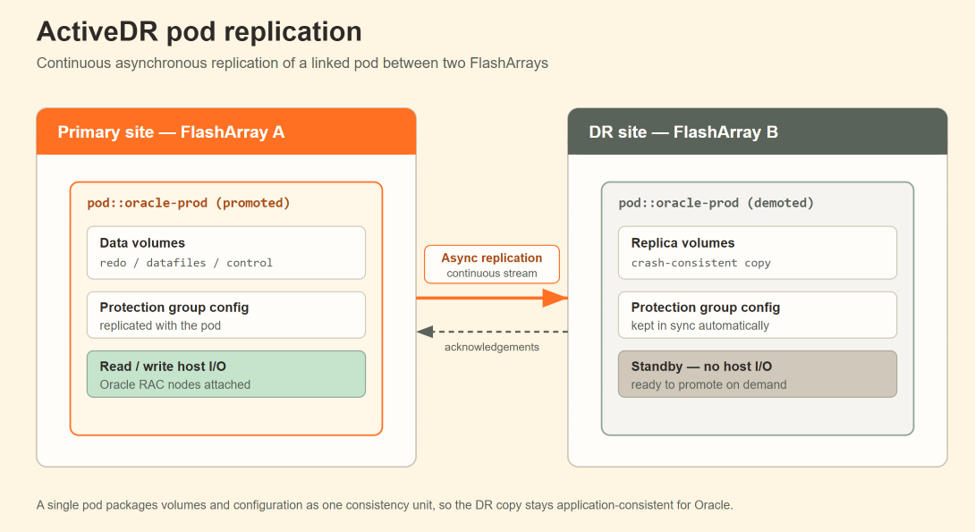
Figure 2. ActiveDR pod‑based replication keeps Oracle data, redo, and FRA volumes continuously protected at the DR site.
A source pod is promoted and writable, while a target pod is demoted until it is needed for testing or failover.
For Oracle, the operational model is straightforward. Create a pod on the source and remote arrays, place the Oracle database volumes in a protection group inside the source pod, and establish a replica link from the source pod to the remote pod.
After the initial baseline completes, ActiveDR continuously transfers changes and the remote copy remains available for controlled promotion when required.
This model is especially useful for Oracle databases because the remote pod can be promoted without forcing a full redesign of the production environment.
DBAs can mount the replicated volumes at the DR site, start the Oracle database there, and validate operational readiness using an up-to-date copy of production data.
Non-Disruptive Testing Is Part of the Value
One of the most practical benefits of ActiveDR is the ability to test disaster recovery without converting a DR event into a production disruption.
During a DR test, teams can follow a controlled workflow: quiesce or redirect production traffic, demote the source pod, promote the DR pod, and bring Oracle online at the remote site without dismantling ongoing protection (see Figure 3).
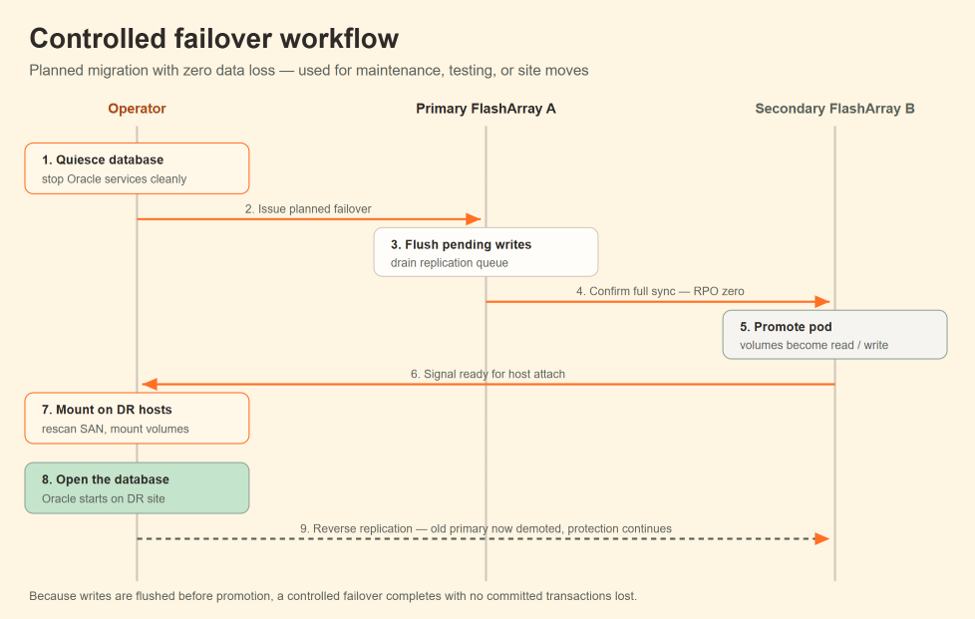
Figure 3. Controlled ActiveDR failover workflow enables repeatable DR tests without disrupting production replication.
That matters because many DR plans look sound on paper but are tested too rarely in practice.
A storage-level model that supports repeatable promotion and validation lowers the operational barrier to testing and gives Oracle and infrastructure teams more confidence that the documented recovery process will work when needed.
Emergency Recovery with ActiveDR
n a real disaster, the workflow shifts from test to recovery. Teams need to detect the outage, understand the latest replicated state on the DR array, promote the DR pod, and rely on Oracle crash recovery to bring the database online with minimal data loss.
ActiveDR provides a predictable sequence for these steps, so infrastructure and database teams are not improvising under pressure. Figure 4 shows an example emergency recovery flow from initial outage detection through planning re‑protection after the DR site has assumed production roles.
Figure 4. Emergency ActiveDR recovery flow used when the primary site is unavailable and DR must assume production roles.
That matters because many DR plans look sound on paper but are tested too rarely in
Where ActiveDR Fits in Oracle DR Strategy
ActiveDR should be positioned as part of a broader Oracle disaster recovery strategy, not as a replacement for every database-native capability.
Oracle Data Guard remains the database-layer standard for redo-based replication and role transition, RMAN remains essential for backup and point-in-time recovery, and ActiveDR provides a storage-based mechanism for continuous asynchronous site protection and rapid recovery activation.
For environments that target near‑zero RPO with flexible distance between sites, ActiveDR’s continuous asynchronous replication provides a storage‑level mechanism to keep Oracle data closely aligned between arrays (see Figure 5). It complements Oracle Data Guard and RMAN by protecting the full volume set.
Figure 5. Near‑zero RPO architecture with ActiveDR continuous asynchronous replication for Oracle databases.
For environments that require zero-RPO business continuity across short distances, Everpure ActiveCluster remains the better fit; for environments that need database-native replication semantics, Data Guard continues to be central.