Data Sovereignty vs. Data Governance
Is data sovereignty the same thing as data governance? That’s a big N-O. While the terms sound similar, and often mistaken for the other, the distinctions are important. It’s best to think of data sovereignty as a subset of data governance.
To understand the relationship between the two concepts, below, we dive into the definitions and ramifications of each and the relationship between them. We also help you understand why they’re both essential for any business that collects data and operates across state or national borders.
As you no doubt know well by now, data governance is impacting your organization’s compliance, resource planning, risk management, and IT architecture functions. The cost of poor data sovereignty or governance can be steep, and not only in terms of regulatory fines.
What Is Data Sovereignty?
Data sovereignty is the set of legal frameworks used by governments to assert control over how citizen user data can be generated, used, and housed, both within borders and beyond, as in the case of international web traffic. Data generated or collected within a specific country is subject to the laws of that location, and jurisdictional control follows the data wherever it is sent.
Key components of data sovereignty:
- Governments have the legal authority to control data created within their borders, including data collected by foreign companies.
- Organizations must comply with regulations like GDPR or CCPA, or face fines or threat of ceasing operations.
- Jurisdictional restrictions apply to data storage, processing, and transfer, and may dictate storage of data within borders.
- Cross-border limitations can govern international data movement.
If this sounds to you like the makings of a compliance nightmare, you’re not alone. For businesses operating globally, remaining compliant can be incredibly complex, but, as we’ll see, this challenge can be met with the right data management platform.
What Is Data Governance?
Unlike the external legal mandates of sovereignty, data governance is an internal discipline that helps ensure compliance. Data governance is the framework that organizations can design to meet their sovereignty requirements.
Data governance includes policies, procedures, and practices that an organization uses to manage their data compliantly and securely. And while compliance with government regulations is surely a topline priority for data governance, the latter may also include internal policies to enhance cybersecurity, data privacy, and resilience. So, data governance is properly seen as a method of observing and remaining compliant with data sovereignty.
In other words, data governance is your program for creating policies and procedures for data management. Addressing data sovereignty is part of the data governance program.
Core components of a data governance framework:
- Data stewardship roles and responsibilities
- Data discovery and classification
- Lifecycle policies from data creation to retention and deletion policies
- Quality management and standardization processes
- Access control mechanisms and user permissions
- Security measures, including encryption and monitoring
- Compliance monitoring and audit trail maintenance
Creating a Compliance Mindset
Data sovereignty compliance—which should be a high-profile part of a data governance program—is non-negotiable and carries severe financial consequences. Organizations face substantial penalties for violations—Google paid $391 million for location data violations,¹ Amazon faced an $886 million GDPR fine,² and Epic Games settled for $520 million over COPPA violations.³
Compliance with data sovereignty regulations requires specific data governance steps around localization requirements, cross-border transfer restrictions, and security standards. These requirements vary significantly between jurisdictions, with Europe’s GDPR representing some of the world’s most stringent protections, while regions like California have implemented their own frameworks through CCPA.
An “internal” compliance approach should be used with data governance to satisfy company requirements in the areas of operational efficiency, cybersecurity, and data privacy. While a data sovereignty compliance failure can result in steep fines and bad publicity, a data breach or successful hack can also result in financial penalties but may also bring tangible harm to customers—and even deeper reputational damage.
Strategic Implementation Considerations
When weighing implementation concerns, remember that data governance is not complete without a strong focus on data sovereignty.
For Data Governance
Successful governance implementation requires alignment and process standardization within the company. This might mean appointing data protection officers, conducting regular data audits, implementing robust access controls, and establishing data quality standards. To work well without stifling innovation, frameworks should be adaptable and fluid to changing regulatory requirements without disrupting core business operations (a common pain point).
For Data Sovereignty
To comply with data sovereignty, organizations must prioritize geographic data placement and legal compliance architecture. This includes:
- Selecting cloud providers with appropriate regional presence
- Implementing data residency controls
- Establishing cross-border transfer protocols that meet regulatory requirements
The complexity increases exponentially for multinational organizations operating across multiple jurisdictions. For example, a French e-commerce company serving California consumers must comply with both GDPR and CCPA requirements, creating overlapping and sometimes conflicting compliance obligations.
Related reading: Compliance vs. Security: Are They Mutually Exclusive?
Data Governance: It’s Not Just about Compliance
In complying with data sovereignty and other regulations, data governance processes can create constraints and friction that can impede performance, potentially limiting analytical capabilities and increasing time to insight. Data localization and cross-border data transfer restrictions can be especially problematic.
That’s why effective data governance becomes not just a matter of compliance, but also of creating data lifecycles that support business objectives qualitatively and performantly. It’s up to DataOps professionals to determine data classification schemes, access control policies, and monitoring procedures that deliver this objective while remaining compliant and secure.
Infrastructure plays a huge role in how manageable and effective data governance is. “Sovereign cloud” services have even emerged recently purporting to provide compliance with data sovereignty “as a service.”
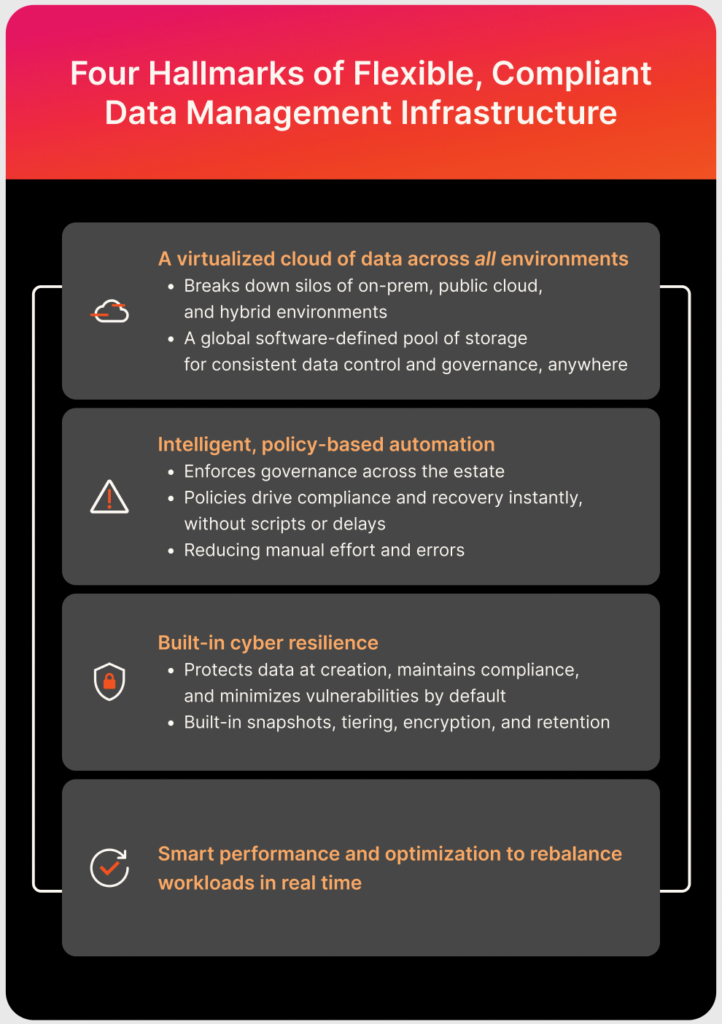
The most effective approach to help implement data governance in today’s complex environment? Unified data storage with access defined by software (“as code”). This way, policies can be defined as needed to satisfy compliance requirements, including visibility and monitoring, as well as business objectives like high-speed and agile access and management.
The Pure Storage platform sets organizations up for success in this increasingly complex data management environment, where data is more mobile and dynamic than ever. Organizations can build an enterprise data cloud that enables smart data governance with: