Changing SQL Server Cyber Resilience Economics with Purity DeepReduce
This is the last installment in our series on rethinking storage efficiency for the AI era. As we’ve already established in previous bloRecovery point objective (RPO) and recovery time objective (RTO) are two critical metrics to define when developing a cyber resilience strategy. RTO and RPO establish how much data can be lost in the face of a disaster and how long it will take to recover that data. Organizations want to lose as little data as possible and recover as quickly as possible, but recovery objectives and budget realities often collide.
In some cases, these metrics are defined based on internal criteria and targets that can be flexible if needed. In other cases, they’re tied directly to customer contracts and compliance requirements.
Organizations need to develop a plan that protects their most critical assets, keeps them in compliance, maintains their ability to meet customer guarantees, and takes into account current market conditions and pricing trends. As costs continue to rise, it becomes harder to reconcile what the business needs with what it can afford.
What can an organization do to balance all of these factors? Sometimes, the answer doesn’t have to involve new infrastructure; sometimes, the answer is simply software innovation. Everpure™ Purity DeepReduce™ is that innovation.
Based on lab testing, Purity DeepReduce can increase effective backup capacity by almost 40% in some use cases.
Real numbers and real innovation
To illustrate the power of DeepReduce, we created a real-world test scenario to simulate a typical weekly backup schedule for a large database:
- Single ~1TB database
- Simulated weekly backup schedule:
- FULL backup on Sunday
- DIFF backups Monday–Saturday
- Daily data change rate of 10% between backups
In the context of SQL Server, this means one large FULL backup per week followed by ever-growing DIFF backups throughout the week. For our testing, we executed a full week’s worth of backups, including an additional FULL to simulate what a typical DBA might keep on their local backup storage.
All testing was completed with and without native SQL Server compression, and with and without DeepReduce. The data set used could be compressed down to 2:1 using SQL Server native compression. The chart below shows the results of our tests.
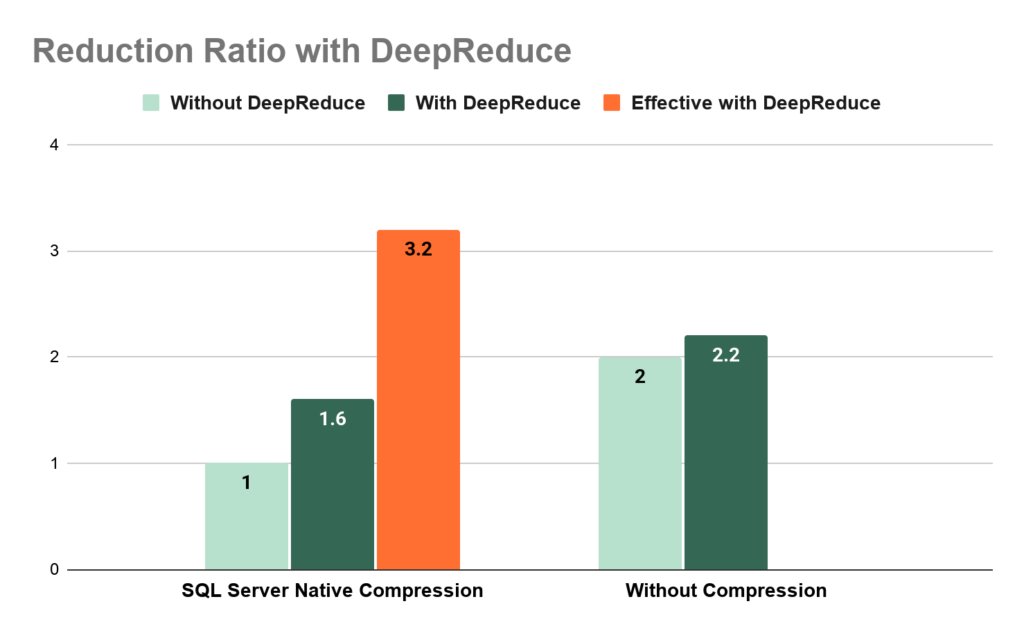
Figure 1: Reduction ratio testing results for SQL Server with and without Purity DeepReduce.
In the case of uncompressed SQL Server backups, DeepReduce was able to reduce the effective size of the backup set by almost 55%. This outperforms SQL Server’s own native compression, which not only saves storage capacity, but also saves on host-side CPU consumption. The story is even more compelling for backups using native compression. DeepReduce was able to further reduce compressed backups (which SQL Server had already reduced by ~50%) by an additional ~37%, for a total effective reduction of ~68%.
This is a material increase in storage efficiency that can allow organizations to implement more aggressive cyber resilience plans while reducing physical storage consumption and still staying on budget.
Take advantage of DeepReduce
DeepReduce is available on FlashBlade//E™, and with the recent addition of DeepReduce to new FlashBlade//S200R2 arrays, organizations now have even more options to take advantage of this technology. To learn more about DeepReduce and what’s possible, read our Purity DeepReduce announcement blog, as well as our engineering series on DeepReduce.