


Summary
Cyber resilience in banking now depends on how quickly institutions can recover critical services from immutable, trusted data using a Minimum Viable Bank strategy to maintain operational resilience during cyberattacks.


For years, much of the cyber resilience conversation in banking looked a little like Catch Me If You Can: Spot the bad actor, stop the breach, block the ransomware, catch the attacker earlier.
Those controls still matter. But they’re no longer enough. Banking leaders are now being asked a harder question: If an attack gets through, can the bank recover the services customers and markets depend on?
Banks are treating cyber resilience more like operational continuity than perimeter defense. When a cyberattack hits a bank, the damage is immediate. Payments stop moving. Trading desks lose visibility. Fraud systems go dark. Customers lose access to accounts. Operations teams start making decisions under pressure.
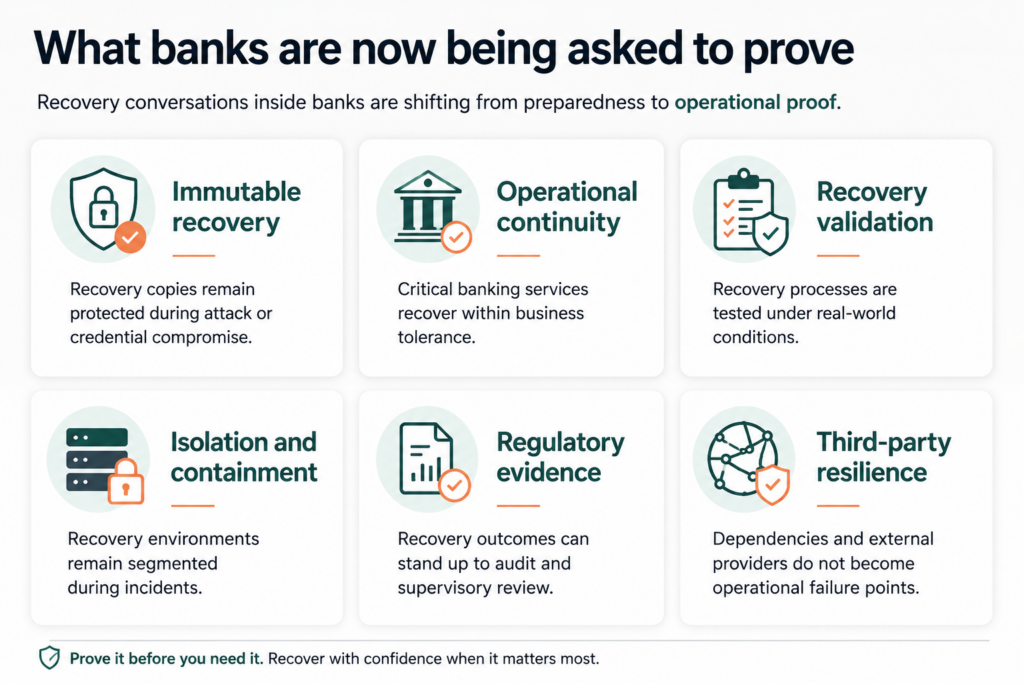
Recovery is becoming the metric that matters most. The question for banks is whether critical services can be restored from immutable, trusted data fast enough to keep the institution operating.
The Ponemon Institute found that recovery after a data security incident takes an average of 12 days. For banking leaders, that number forces banks to decide what must recover first: which services must come back first, how recovery is proven, and whether the institution can stand behind its recovery plan under real pressure.
The executive brief combines Ponemon research with perspectives from Michael Russo, GM, Financial Services at Everpure, and Rob Glanzman, Global Strategic Alliances Principal Architect, Financial Services at Everpure.
“What most banks still think of as resilience—disaster recovery and failover—was built for outages, not cyberattacks. And that model no longer works.”
–Rob Glanzman, Global Strategic Alliances Principal Architect, Financial Services, Everpure
“Security is no longer measured solely by blocked attacks. It is measured by sustained operations under attack.”
– Rick Orloff in The Data Wire
Why traditional recovery models are under pressure
Traditional disaster recovery models were built for infrastructure failure. If a server goes down and the data center fails, then the system needs to be restored from backup.
Cyber events change the recovery equation. Attackers may target credentials, recovery copies, administrative tools, and backup environments. Production systems and recovery systems may both be compromised.
Recovery plans that pass in a safe environment can still break during a live event when teams are validating data, isolating environments, making business-priority decisions, and managing regulatory scrutiny at the same time.
That is where recovery plans start to break. Recovery copies may already be compromised. Recovery environments may not stay isolated. Critical banking services may take longer to restore than the business can tolerate.
The shift toward Minimum Viable Bank
One of the biggest changes inside banking resilience programs is the shift toward a Minimum Viable Bank (MVB) approach.
MVB is the set of critical services a bank must restore first to keep operating during a cyber or operational disruption.
It’s a business-first recovery model. All applications are not equal. In a MVB approach, the bank identifies the services that must come back first because they protect customer access, market activity, regulatory obligations, and institutional trust.
For most banks, MVB services include payments, digital banking access, fraud systems, trading operations, treasury functions, and core transaction processing.
The executive brief explores how banks are prioritizing these services and where recovery plans tend to fail under pressure.
“Everpure is focused on giving banks the confidence that they can recover their Minimum Viable Bank from immutable data in hours, not days, and that they can actually stand behind it.”
–Michael Russo, GM, Financial Services, Everpure
For banking leaders, MVB planning quickly turns into operational accountability: Can the institution restore priority services from immutable data within business tolerance?
Why download the executive brief?
The brief gives banking leaders a sharper way to frame cyber resilience around recovery, operational continuity, and MVB planning.
In the brief, you’ll:
- See how leading banks are redefining resilience around immutable, trusted data.
- Learn the building blocks of a MVB that can run during disruption.
- Understand where legacy backup and recovery models break and how to close the gaps.
- Get practical guidance from Everpure financial services experts.
Ready to future-proof banking resilience?
Download the executive brief, “Cyber Resilience in Banking: Building the Minimum Viable Bank,” to learn how banks are rethinking recovery, operational continuity, and resilience under real-world cyber conditions.
Read the Solution Brief
“Strengthening Cyber and Operational Resilience in Banking”