Summary
AI-ready data is essential for AI ROI. With real-time, connected, contextual data infrastructure, enterprises can move AI projects from proof of concept to production.


The AI revolution is hitting a bottleneck, and many organizations are struggling to move from experimentation to production-ready AI at scale. For the leaders accountable for AI, that gap is personal: it’s the difference between defensible ROI and a stalled program the board is asking about. So, where is this gap? The truth is that most enterprises still lack the foundational component that makes AI actually work: data readiness.
While this is a buzzworthy phrase, it’s deserving of the buzz. What is data readiness? It’s when an organization’s raw, fragmented data has been sufficiently prepared, governed, curated, classified, contextualized, vectorized, indexed, and structured so that it can be immediately and safely utilized by AI models, agents, and analytics engines.
Let’s take a deeper look into what data readiness means and why it’s become the make-it-or-break-it infrastructural flashpoint of AI ROI.
Spend all you want—if your data’s not ready, your AI won’t be either
Worldwide AI spending is expected to hit $2.5 trillion this year, but more than half of enterprises still see almost half of AI projects fail due to lack of data readiness. Organizations pour resources into AI initiatives, hire data scientists, and deploy sophisticated models, only to discover their data infrastructure can’t support the demands of production AI.
The result? AI projects that never make it beyond proof of concept.
The question then becomes: What does AI-ready data actually look like?
The ‘Four Cs’ of AI-ready data
“AI-ready” used to mean “clean, labeled, and stored somewhere we can find it.” Today, readiness isn’t just about having large volumes of data; it’s about having data that AI systems can consume efficiently, consistently, and at scale.
AI-ready data is:
If your data only shows up in nightly batches or after a two‑month prep slog, your AI will always be late to the conversation.
Picture your first big enterprise AI win: An autonomous customer support agent that not only retrieves troubleshooting steps but actively spins up a testing environment, drafts a code patch, and verifies the fix before asking a human engineer for final approval.
Now imagine that behind the scenes. Those answers depend on:
- Weekly data exports from CRM and ticketing tools
- Weekly data exports from CRM and ticketing tools
- A fragile ETL chain
- A batch job that rebuilds embeddings once every few days
On a slide, that looks like “AI-ready” data. In real life, it means your AI is always at least one change behind reality—and your teams know it. They stop trusting the answers, and your “AI success” quietly reverts back to manual lookups and Slack threads.
What you need for AI data readiness
For modern RAG, copilots, and agents, AI-ready data has three non-negotiables:
- It’s live, not lagging. The data your models see is only minutes (or even seconds) behind what’s in your operational systems. When legal updates a clause or product ops changes a SKU, your AI reflects it almost immediately, without waiting for a batch window. Modern AI applications, especially those involving retrieval-augmented generation (RAG) and agentic systems, can’t wait for those windows; they require data in real time.
- It’s delivered as a stream, not as a project. Unlike even a couple of years ago, today you’re not spinning up a two-to-four-month pipeline effort for every new AI use case. Instead, you need data to flow continuously into your vector stores, models, and agents. As AI models grow larger and more complex, you need data streams that automate the delivery of AI-ready data from the source.
- It’s reachable from one backbone. AI workloads don’t care which system “owns” the data—they just need to read it, fast. Structured, unstructured, log, and object data all sit behind a unified high‑performance layer. Training a large language model might require terabytes of text data, while inference operations need rapid access to vector embeddings, model weights, and contextual data—all with microsecond latency.
- It has built-in context: this means the semantic meaning, business relationships, and governance rules travel with the data, rather than being trapped inside siloed applications.
Why you don’t have the data readiness you need (yet)
Of all the architectural components of AI, storage represents the most complex infrastructure challenge in AI deployment. That’s because data readiness is no longer just a question of physical capacity or speed—it requires bridging raw data infrastructure with active semantic intelligence.
To fuel effective enterprise AI, a modern data platform must deliver on two critical fronts simultaneously:
- Real-time data streams: Delivering data at wire speed to keep hundreds of GPUs fed with information. High-throughput, low-latency pipelines ensure that embeddings, model checkpoints, and live operational logs are processed natively without starving GPU compute.
- Continuous data context: Injecting raw data with immediate business meaning. Through Everpure Data Intelligence, data is automatically mapped into a universal semantic knowledge graph. This means data carries its own relationships, definitions, and governance rules directly at the storage layer.
When you pair lightning-fast data delivery with built-in context, you eliminate the “confident nonsense” of AI hallucinations. Instead of forcing autonomous agents to waste compute guessing how disconnected databases align, you provide them with a self-describing, real-time data environment that is instantly ready for action.

AI-ready vs. AI not-ready
Let’s make it concrete.
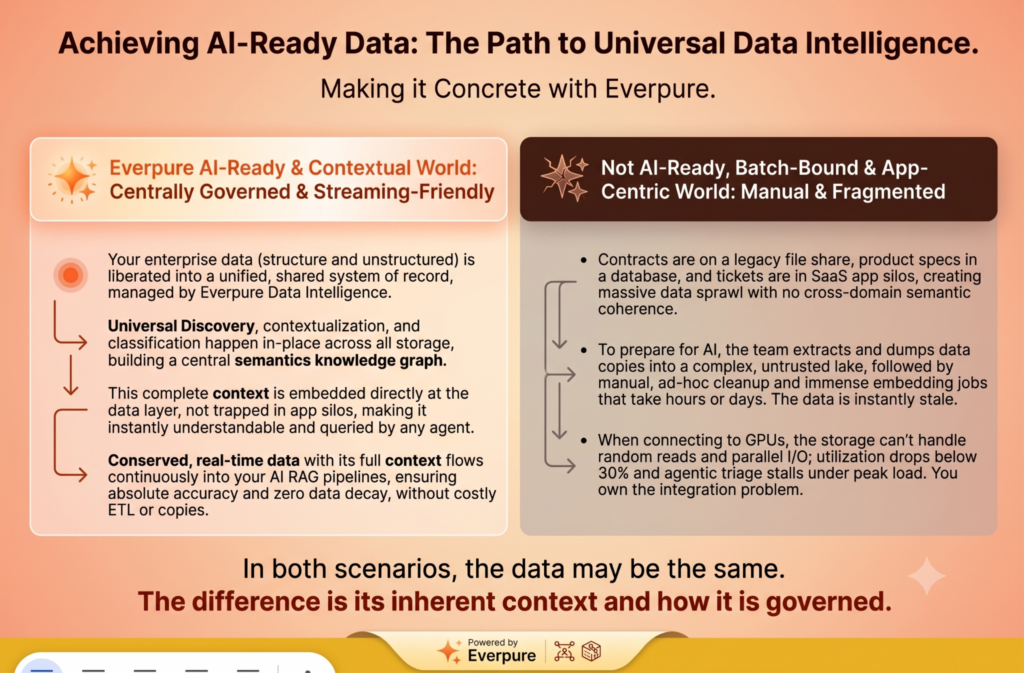
AI-ready, streaming-friendly world:
- A support copilot reads policies from a unified storage platform that serves both file and object data at flash speed.
- New tickets, docs, and product notes flow continuously into a RAG pipeline that updates embeddings and indices in near real time, driven by stream‑like ingestion instead of infrequent ETL.
- During a launch event, traffic spikes. GPUs pull data in parallel from a scale‑out storage layer that sustains throughput and low tail latency, so utilization stays high and responses stay snappy.
Not AI-ready, batch-bound world:
- Contracts are on a legacy file share, product specs in a database, tickets in SaaS, and logs in object storage—with no single, high‑performance way to read across them.
- To get “AI-ready,” the team dumps everything into a lake, runs manual cleanup, then kicks off a big embedding job that may take hours or days. Updates wait until the next batch.
- When you finally connect it to GPUs, storage can’t keep up with the random reads and parallel I/O, so utilization drops below 30% and inferencing stalls under peak load.
In both scenarios, the data may be the same. The difference is how it moves.
From ‘ready’ to ‘real time’
1. Turn pipelines into continuous flows
Instead of large, fragile batch jobs, design RAG and agent pipelines as continuous, resumable streams:
- New or changed records automatically trigger ingestion, transformation, and embedding updates.
- Your storage backbone supports high‑throughput, parallel writes and reads without needing to copy data across multiple silos first.
- Failure handling is built in—if a node goes down, the stream resumes without a week‑long rebuild.
2. Inject semantic and unified data context
Raw data without meaning forces AI agents to hallucinate or waste compute trying to guess how disjointed datasets connect:
- Leverage Everpure Data Intelligence to automatically map raw data across your entire estate into a universal, semantic knowledge graph.
- By embedding this context directly into the storage substrate, the data becomes self-describing, meaning business logic and relationships travel with the data rather than being trapped in application silos.
- Exposing this rich context via open standards (like the Model Context Protocol) ensures autonomous agents receive accurate, real-time context windows without complex, manual engineering.
4. Make scaling and changes non-events
The less operational overhead you carry, the more new streaming AI use cases you can stand up. And, real‑time AI platforms don’t have the luxury of downtime:
- You can add capacity or performance to the storage layer without taking systems offline or rearchitecting the pipeline.
- The same platform supports training, fine‑tuning, and inference workloads without forcing new data copies or separate storage silos.
5. Start with latency, not just cleanliness
Most teams start with governance, quality, and schema hygiene—and those matter. But for AI, “how old is this data when the model sees it?” is just as important as “is it correct?”
- Define freshness SLAs per use case: seconds for trading, minutes for support, maybe hours for offline analytics.
- Treat those SLAs as hard requirements for your storage and pipelines, not as “nice‑to‑have” attributes.
Where the AI data platform (and Everpure) comes in
This is exactly where a data platform—and especially an AI‑focused storage backbone—earns its keep. An AI data platform built on all‑flash, scale‑out storage can:
- Automate ingestion from raw data to real-time insights. Leveraging Everpure Data Stream (built on the NVIDIA AI Data Platform reference design), the platform replaces manual data preparation with a GPU-accelerated pipeline. This reduces the time it takes to convert unstructured data into AI-ready streams from months to mere minutes, ensuring GPU clusters are never starved for data. .
- Expose unified file and object access with built-in semantic context. Instead of bouncing between disconnected systems and data copies, LLMs and RAG pipelines access a high-performance pool injected with Everpure Data Intelligence. This architecture maps data dependencies into a universal semantic knowledge graph available via the Model Context Protocol (MCP), ensuring autonomous AI agents always receive highly accurate, real-time context.
- Maintain end‑to‑end locality with the GPU stack. Tight integration with GPU platforms enables direct data paths that reduce CPU overhead and tail latency, keeping real‑time and streaming workloads responsive.
- Scale and upgrade without disruption. Non‑disruptive expansion means your always‑on AI services keep running while capacity and performance scale beneath them.
Layer an Enterprise Data Cloud on top—governance, security, multi‑cloud mobility—and you have an AI data platform designed not just to hold data, but to deliver it, continuously, where your AI actually lives.
That’s the real pivot: from “do we have enough data?” to “can our data move at the speed our AI needs?” When the answer is yes, AI ROI stops being a promise and starts showing up in live dashboards, support queues, and board‑level metrics.
What does this mean for your AI strategy?
Learn how Everpure helps organizations build AI-ready data foundations with unified access, real-time delivery, and the performance needed to keep AI moving from pilot to production