

Summary
Simple backups aren’t enough in the face of unpredictable crises. A continuous recovery architecture can enable organizations to not only meet DORA and NIS2 compliance but also transform operational resilience into a competitive advantage.


Operational resilience is no longer optional—it’s now a regulatory imperative. With the entry into force of the Digital Operational Resilience Act (DORA) and the NIS2 Directive, organizations—especially financial institutions, industrial firms, and essential service operators—must demonstrate their ability to maintain the continuity of their critical services even in the face of major cyberattacks or disasters.
These new obligations demand a paradigm shift: The backup ecosystem, which has long been relegated to purely copying and retention duties, becomes a central component of cybersecurity, and more broadly, of business continuity.
From CI/CD to CR: When Recovery Becomes a Continuous Process
Continuous integration/continuous delivery (CI/CD) practices have helped companies make development cycles more reliable and faster. But today’s operational realities require a new layer: continuous recovery (CR).
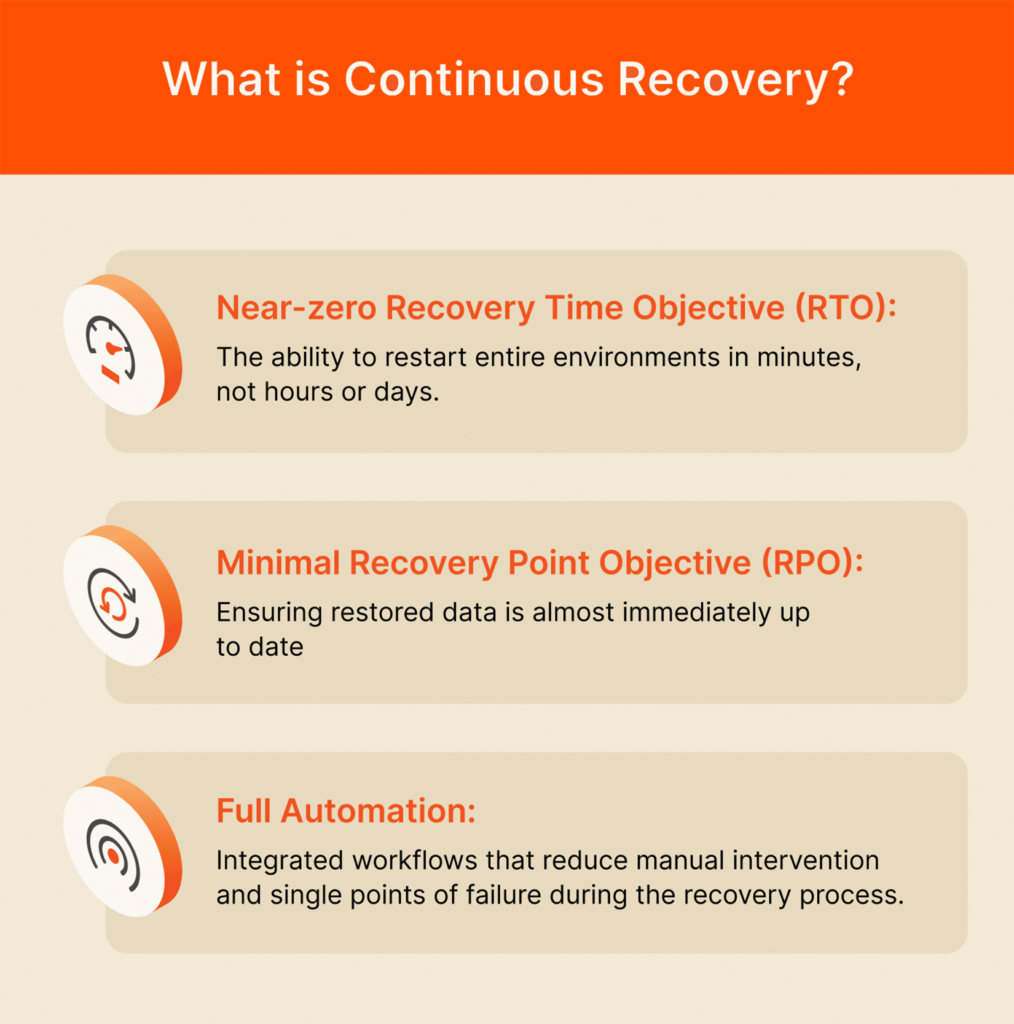
This model forces convergence between production and backup, using platforms capable of handling both application load and massive recovery operations—without compromising performance.
Evolution of the Backup Ecosystem: From the Predictable to the Unpredictable
Historically, backups were limited to copying data to defend against predictable events (hardware failures, human error, etc.). But in a world where cyber threats and operational crises are multiplying, companies must anticipate unpredictable scenarios. This means:
- A high-performance, scalable backup platform, capable of real-time verification, malware scanning, and intelligent tagging of data
- Deployment of a multi-weapon response that combines multiple protection and restoration mechanisms (traditional backups, replication, snapshots, write once read many [WORM], cloud-based recovery)
- Support for diverse data copy formats, covering everything from primary production workloads to long-term documentary archives
Backup ≠ Archive
In this context, distinguishing operational backup (fast, tested, ready to restore) from archive (long-term, compliance) becomes essential. At Pure Storage, we enrich these processes with systematic use of immutable snapshots that supplement classic backups. Thanks to SafeMode™, these snapshots remain protected even against rogue admin attacks. For object storage, our WORM certification offers similar guarantees, especially for sensitive archives.
- Immutable and continuous snapshots to protect data against corruption or malicious deletion
- Hot restoration directly from the primary platform
- Logical separation and enhanced security (air gapping, multi-factor authentication, granular roles)
- Native orchestration across hybrid and multicloud environments
- Support for multiple protocols: Object, SMB, NFS, etc.
The Enterprise Data Cloud: A Resilient Ecosystem
To meet these new demands, data players have had to innovate.
Pure Storage has made heavy investments in this area, and with FlashBlade®, we offer an effective answer. This scalable, unified platform delivers unmatched performance—thanks to flash technology—and embedded intelligence via our Purity software, as well as efficiency, simplicity, resilience, and security. All of this while taking into account new challenges related to energy, carbon footprint, and data center impact.
The Enterprise Data Cloud strategy model initiated by Pure Storage treats data globally rather than in silos. All solutions are centered on data challenges. FlashBlade helps meet stringent SLAs imposed on industries and, above all, delivers on the idea of continuous restoration thanks to its performance.
Why Pure Storage Makes a Difference
These new constraints call for a profound rethink of architecture, requiring the introduction of flash-based platforms to absorb the load of advanced processing without degrading performance.
Traditional platforms are not built for the level of performance and availability required today. Flash, at the heart of Pure Storage architecture, offers three major levers:
- Linear Performance at Scale
- Massive environment restoration without bottlenecks
- Ability to test DR/BCP regularly without impacting production
- Integrated Security
- Immutable snapshots protected via SafeMode
- WORM certification for object environments and regulatory archival
- Flexible retention with granular access control
- Operational Simplicity and Multicloud
- A unified platform for production, backup, and recovery
- Native hybridization with public cloud, allowing resilience extension without performance loss
- Automation via APIs and integration with CI/CD and backup orchestrators
Continuous Recovery: The New Normal
Implementing CR is not optional to meet DORA and NIS2—it’s a condition for sustainable compliance and real continuity in the face of unpredictable crises.
With Pure Storage, organizations get a flash and multicloud ecosystem designed to:
- Guarantee the performance needed for continuous recovery
- Provide security that is inherently integrated
- Simplify operations while strengthening compliance
By moving from simple backup to a continuous recovery architecture, companies do more than align with DORA and NIS2—they gain a durable competitive advantage.

The State of Cyber Resilience
Learn how 620 US-based IT security practitioners are approaching data storage security in the age of AI.
The State of Cyber Resilience
Learn the security strategies of 620 US-based IT security practitioners.