Summary
DirectFlash, global flash management, and a fully optimized data layout enable the Everpure platform to become more efficient as it scales, allowing organizations to achieve the highest performance and density while minimizing complexity and overhead.


What happens when organizations struggle with hidden inefficiencies in their storage infrastructures? A staggering amount of energy, capital, and human attention is wasted: every watt of power consumed unnecessarily, every rack unit filled with underutilized hardware, every hour spent tuning storage parameters. It’s not just wasted resources—it’s the wasted opportunity.
In this post, we’ll delve into the architectural simplicity and economic efficiency of the Everpure platform that make a true EDC a reality.
At its core, the Enterprise Data Cloud is built on four foundational pillars:
- Unified data plane – one intelligent fabric for all data
- Global intelligence – software-driven optimization across the entire system
- Autonomous operations – self-tuning, self-healing infrastructure
- Predictable economics – efficiency that compounds as you scale
Storage efficiency isn’t just one pillar—it’s the force multiplier that makes all four possible.
Learn how The Access Group applied EDC to run leaner, move faster, and stay safer at a global scale:
The Inefficiency of the Legacy Approach
For decades, we’ve accepted a fundamentally flawed model for enterprise storage. Arrays filled with SSDs, each containing its own processor, RAM, firmware, and flash translation layer, required highly specialized engineers to manually configure parameters to balance performance, protection, and capacity. This came with periodic performance degradation during uncoordinated maintenance tasks and disruptive upgrades every three to five years.
It’s like building a modern city where every building operates its own power plant instead of connecting to a central grid. Customers pay for these inefficiencies—not just in acquisition costs but in rack space, power consumption, cooling requirements, and operational complexity.
When we founded Everpure, we asked: What if we could eliminate these inefficiencies at the architectural level rather than compensating for them? We challenged the assumption that each storage device needed its own intelligence. We questioned whether administrators should be forced to make complex RAID configuration choices. We rejected the notion that efficiency must come at the expense of performance or resilience.
The result: a storage platform that actually becomes more efficient as it scales, and efficiency at scale is what unlocks architectural simplicity by unifying operations across the data cloud. Here’s how.
DirectFlash: Breaking Free from SSD Constraints
We have a saying at Everpure: “Storage isn’t a capacity problem—it’s a physics problem.” While it might seem counterintuitive—most storage discussions do tend to revolve around terabytes and petabytes—the statement is spot on. The most profound innovations in storage aren’t about simply adding more capacity; they’re about fundamentally changing how we interact with the underlying physics of the media.
DirectFlash® is what allows Everpure to treat flash not as isolated devices, but as a single, unified data plane—the first requirement for an Enterprise Data Cloud. In traditional systems, every SSD contains its own flash translation layer (FTL)—software that manages how data is written to and read from the physical flash cells. Each SSD independently makes decisions about data placement, garbage collection, and wear leveling without any awareness of what the system is doing as a whole.
Everpure DirectFlash® technology fundamentally redefines this by removing the traditional SSD controller architecture, enabling direct access to raw NAND flash without embedded controllers or on-board DRAM. This creates efficiency with:
- Elimination of redundant resources: In a traditional 24-drive system, you might have 24 controllers, 24 sets of firmware, and potentially terabytes of DRAM just inside the drives themselves. DirectFlash eliminates this redundancy, reducing hardware costs and power consumption.
- Unprecedented visibility: Without the black box of SSDs, Purity can see when cells are being programmed, erased, or read. It can also see the health and endurance of every region of flash, allowing us to make smart decisions impossible in traditional architectures.
Global Flash Management: The Intelligence Layer
Imagine if instead of having individual traffic lights making independent decisions at each intersection, you had an intelligent system that could see all traffic patterns across an entire city and optimize flow globally. That’s the difference between traditional SSDs and Everpure DirectFlash technology. Instead of optimizing individual components, we optimize the entire system through our Purity global flash management—the intelligence that orchestrates how data flows across the entire flash pool.
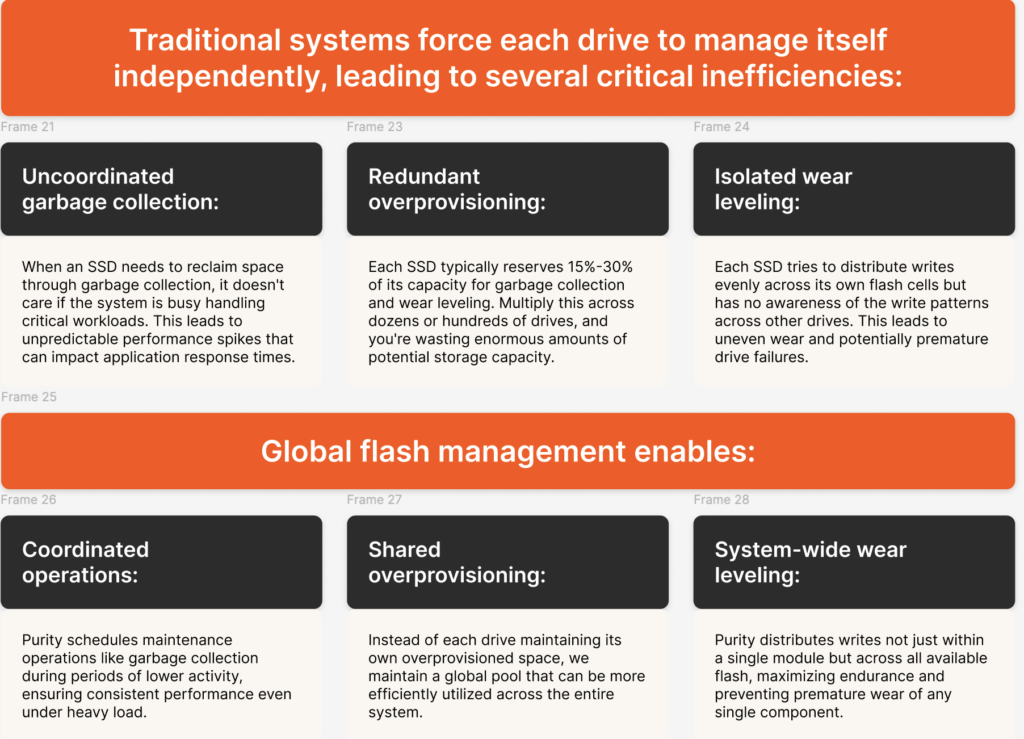
Traditional systems force each drive to manage itself independently, leading to several critical inefficiencies:
- Uncoordinated garbage collection: When an SSD needs to reclaim space through garbage collection, it doesn’t care if the system is busy handling critical workloads. This leads to unpredictable performance spikes that can impact application response times.
- Redundant overprovisioning: Each SSD typically reserves 15%-30% of its capacity for garbage collection and wear leveling. Multiply this across dozens or hundreds of drives, and you’re wasting enormous amounts of potential storage capacity.
- Isolated wear leveling: Each SSD tries to distribute writes evenly across its own flash cells but has no awareness of the write patterns across other drives. This leads to uneven wear and potentially premature drive failures.
Global flash management enables:
- Coordinated operations: Purity schedules maintenance operations like garbage collection during periods of lower activity, ensuring consistent performance even under heavy load.
- Shared overprovisioning: Instead of each drive maintaining its own overprovisioned space, we maintain a global pool that can be more efficiently utilized across the entire system.
- System-wide wear leveling: Purity distributes writes not just within a single module but across all available flash, maximizing endurance and preventing premature wear of any single component.
The result? Our customers typically see two to five times better endurance from the same flash compared to traditional approaches, along with consistently lower and more predictable latency.
The Compounding Economic Benefits of Extreme Efficiency
As data volumes grow, how these three elements—DirectFlash, global flash management, and optimized data layout—work together is where the economic benefits start to compound:

- Exponential efficiency gains: When multiple racks of legacy all-flash storage can be replaced with a single Everpure FlashArray™, not only are the gains in performance and capacity, but also reduced power consumption and more valuable data center space.
- Predictable performance at scale: As systems grow larger, the efficiency advantages become even more pronounced. While traditional systems often see performance degradation as they scale, Everpure systems maintain consistent, predictable performance regardless of size.
- Simplified management: The autonomous, self-tuning nature of our platform means administrators spend less time optimizing storage and more time delivering value to the business—from 16 hours per week to less than an hour.
When inefficient storage is no longer a limiting factor, organizations can do more without compromise. But it’s more than just the immediate technical and economic benefits—it’s how this foundation enables a truly unified enterprise data platform.
Efficiency as the Foundation for Enterprise Cloud Economics
The economics of enterprise cloud models depend on storage efficiency. Why? When you eliminate inefficiencies in the storage layer, you create a foundation for a unified data experience across all workloads, deployment models, and data types. The result is a platform that delivers extreme performance density while drastically reducing the management overhead that constrains traditional storage.
By eliminating device-level inefficiencies, implementing software-driven global intelligence, and automating optimization, the Everpure platform enables organizations to achieve true cloud-like efficiency for all data workloads.
That’s what allows data to move freely, perform instantly, and remain manageable as environments grow more complex—turning storage efficiency into the foundation of true cloud-like data fluidity.