Summary
Most AI failures aren’t caused by models—they’re caused by data that lacks context, trust, and governance. This post reframes data intelligence as an infrastructural capability that enables contextual AI, connecting metadata, architecture, and real-time data pipelines. The result: AI systems that don’t just process data, but understand it well enough to drive reliable outcomes at scale.


If you’ve ever experienced “option anxiety,” where there are too many choices and you feel like no matter which one you choose, you’ll be missing out on something else from making that choice, you’ll understand what makes data intelligence so important.
AI systems experience this same sort of option anxiety because they often aren’t sure what data to focus on.
That’s where data intelligence comes in.
Much more than just another tech buzzword, the concept of data intelligence has arrived for a really good reason: to help enterprises make sense of the massive volumes of AI data being generated within their (usually siloed) systems—data that often goes unnoticed, ungoverned, and unused.
Let’s look at what data intelligence is, what makes it work, and what kind of architecture you need to make data intelligence easy and cost-effective.
“Here’s the number that should stop every data leader cold: 84% of enterprise AI projects are failing before they even start. Not because of their model. Not because of their GPU. Not because of the budget. But because the data isn’t understood, governed, or trusted.” – Shawn Rosemarin, VP Product Management, Everpure, Beyond the IT Headlines Podcast
What is Data Intelligence?
The term “data intelligence” is already in use, with most definitions essentially saying the same thing:
Data intelligence is the process of making data understandable, trustworthy, and usable at scale so that it can consistently drive decisions and outcomes.
While this is a perfectly solid definition of data intelligence, it lacks one very clear and important point: Data intelligence shouldn’t be seen as just another layer; it should be seen as an infrastructural component.
Also, to be clear, we’re really talking about enabling AI. According to most definitions, data intelligence helps you analyze data for the sake of AI. But we’re saying data intelligence determines whether AI works at all.
If you see data intelligence as just another layer, you’re going to have another headache on your hands: More layers mean more silos, which mean more communication breakdowns and more sunk, unrecoverable costs.
But…
What if clean, contextual, AI-ready data was something you couldn’t just occasionally have if you string together enough brains and arms and systems and solutions and money and hard work, and layers, but something you could operationalize from a central command center the way a thermostat operationalizes a home’s heating?
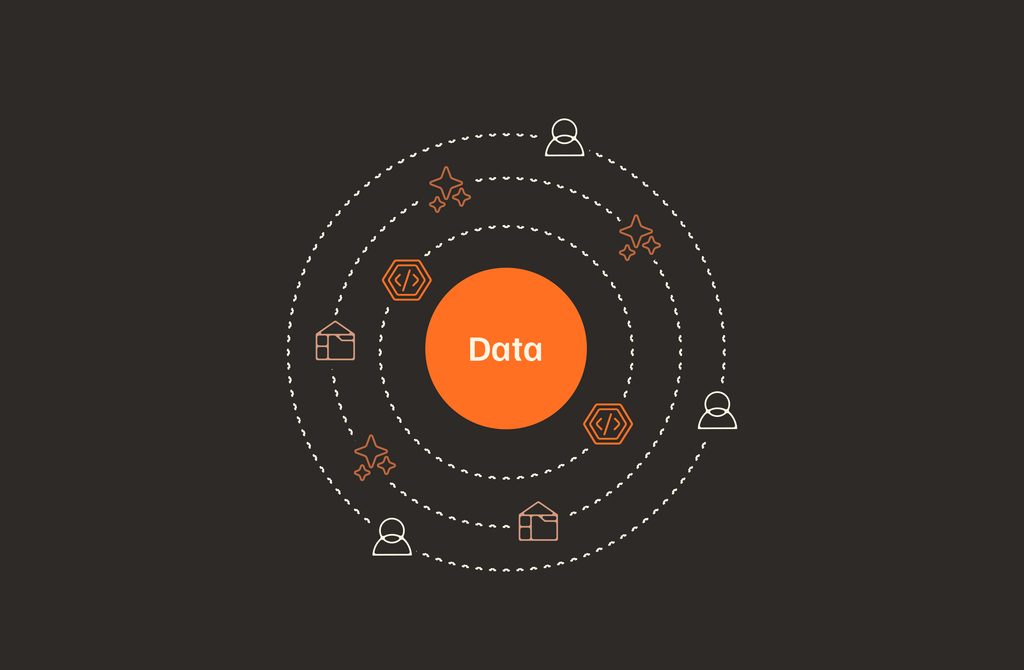
That’s why we define data intelligence a little differently. We define it as: the ability, at an infrastructural and operational level, for AI systems to derive contextual meaning from data.
Data Intelligence vs Data Management
Data management is still seen as the stewardship of data—ensuring accuracy, availability, and proper governance. But most enterprises nowadays understand data management as table stakes. Data intelligence represents the next step: using AI systems to learn, understand, and reason on organizational data to extract actionable insights.
Data management answers: “Where is my data? Is it accurate? Can I access it?”
Data intelligence answers: “What does this data mean? How does it relate to other information? What context is needed for AI to use it correctly?”
Data Analytics vs. Data Management vs. Data Intelligence
|
Category |
Data Management |
Data Analytics |
Data Intelligence |
|---|---|---|---|
|
Primary Goal |
Store, organize, and maintain data |
Extract insights from data |
Ensure data is trusted, usable, and actionable |
|
Core Focus |
Infrastructure and control |
Analysis and outcomes |
Context, trust, and enablement |
|
Key Question |
“Where is the data and how is it handled?” |
“What does the data tell us?” |
“Can we trust and effectively use this data?” |
|
Scope |
Data storage, integration, governance basics |
BI, reporting, ML, forecasting |
End-to-end data lifecycle + metadata + AI |
|
Typical Capabilities |
Data storage, ETL, databases, data pipelines, backup |
Dashboards, queries, statistical models, ML |
Data cataloging, lineage, quality, governance, AI-driven insights |
|
Data Types |
Structured & unstructured |
Structured (mostly), some unstructured |
All data + metadata + context |
|
Users |
IT, data engineers |
Analysts, data scientists |
Entire organization (IT, data, business, compliance) |
|
Outputs |
Available, organized data |
Reports, predictions, insights |
Trusted, governed, discoverable data |
|
Time Horizon |
Operational (keeping systems running) |
Tactical (decision-making) |
Strategic (scaling data-driven business) |
|
Dependency Relationship |
Foundation layer |
Built on managed data |
Spans and enhances both layers |
Data intelligence vs Data analytics
Data analytics and data intelligence are often used interchangeably, but they solve very different problems. Data analytics is about extracting insights—identifying patterns, trends, and predictions from existing data sets to inform decisions. It’s the dashboard, the model, the forecast. But analytics assumes the data it’s working with is already reliable, accessible, and meaningful. That assumption is where many organizations run into trouble.
Data intelligence operates one layer deeper. It focuses on making data trustworthy, governed, and usable across the business—connecting metadata, lineage, quality, and policy with AI-driven automation to ensure the right data reaches the right people at the right time. In that sense, data intelligence isn’t a replacement for analytics—it’s what makes analytics work at scale. Without it, insights are fragile and siloed; with it, they become consistent, explainable, and actionable across the enterprise.
Context: the key to making data intelligence work
Depending on how old you are, you may remember printing out directions from a map website before a road trip—pages of turn-by-turn instructions you had to trust were still accurate by the time you hit the highway.
Data in most enterprises still works like that: static, outdated, and disconnected from what’s actually happening in the moment.
Contextual AI is what happens when you replace those printed directions with something more like a GPS: continuously updated, context-aware, and able to guide decisions in real time—not just describe what happened yesterday.
If you’re a C-suite person, you just want to know how to build better, more efficient AI. The answer is contextual awareness: the capability for AI systems to understand not just what data says, but what it means in specific business situations, time periods, and operational contexts. Basically, AI at its practical best.
Data intelligence is the foundation of contextual AI, and contextual AI is what allows enterprises to extract the most possible value from their AI investments.
What truly enables contextual data at an architectural level?
In-band vs. out-of-band metadata architectures
The terms “in-band” and “out-of-band” originate from network management but have important implications for storage systems and AI workloads. Understanding this distinction helps clarify why certain architectural approaches provide efficiency advantages.
In-band systems operate within the same pathway as production data, sharing the critical data path. Management traffic and data traffic use the same network infrastructure and processing resources.
Management and data operations share the same path and process original data in the critical flow but are more vulnerable to congestion and failures and can create performance bottlenecks when not properly architected.
Out-of-band systems operate on a separate, dedicated pathway that exists independently from the primary data flow. In networking, this means a dedicated management plane separate from the data plane. In storage systems, it means processing operations (like metadata management or data migration) through separate pathways or at different times than primary data operations. While efficient in-band metadata is critical for production performance, out-of-band approaches remain valuable for specific AI infrastructure needs:
- Monitoring and observability: Analyzing AI cluster performance without impacting production workloads
- Data migration and tiering: Moving cold data between performance tiers without disrupting active training
- Compliance and auditing: Scanning for sensitive data and maintaining governance without production impact
Proper Use of Metadata
In traditional storage systems, metadata operations—the lookups, updates, and traversals needed to locate and manage data—often create performance bottlenecks when they share the data path with large data transfers.
The problem manifests as a “queuing delay”: small, latency-sensitive metadata operations get stuck waiting behind large data packets, like a little grain of sugar having to wait behind an elephant. This congestion becomes particularly acute in AI workloads.
Here’s where architectural sophistication creates differentiation: efficient approaches handle metadata in-band (within the primary data flow) but prevent it from creating bottlenecks through intelligent separation and acceleration.
Advanced storage architectures achieve this through separated metadata engines.
By offloading metadata operations to dedicated processing resources while keeping them logically in-band, modern storage systems eliminate queuing delays. Metadata operations don’t get stuck behind data transfers because they use separate processing paths, even while remaining part of the unified data access flow.
Benefits of in-band metadata processing (when properly architected) include:
- Lower latency: Metadata lookups happen in microseconds without waiting for data operations
- Higher parallelism: Multiple clients can access different parts of the namespace simultaneously
- Unified consistency: Metadata and data updates maintain atomicity without complex synchronization
- Efficient AI access patterns: Random reads across millions of small files don’t create metadata storms
You can accelerate overall system performance by moving metadata out-of-band but also by architecting in-band metadata handling that’s fundamentally efficient. Storage systems with efficient in-band metadata handling eliminate these bottlenecks, keeping AI systems running at full performance. systems with efficient in-band metadata handling eliminate these bottlenecks, keeping AI systems running at full performance.
How Everpure Enables Data Intelligence
Modern AI doesn’t fail because of models—it fails because data lacks context. The Everpure approach centers on turning raw data into intelligent, context-rich information through the Enterprise Data Cloud (EDC), where data is unified, governed, and enriched at the source. Within EDC, innovations like DirectFlash®, the Pyramid metadata architecture, and FlashBlade//EXA™ eliminate traditional metadata bottlenecks by centralizing, accelerating, and scaling contextual data access across a single namespace.
On top of this foundation, Everpure Data Stream operationalizes data intelligence by embedding context directly into data pipelines—automating chunking, enrichment, and transformation so AI systems receive not just data, but meaning. The result is a system where context is not bolted on later, but built into the infrastructure itself—enabling faster retrieval, more accurate reasoning, and scalable, production-ready contextual AI.
Finally, Everpure recently announced its intent to acquire 1touch, which will enable full data contextualization within EDC.
“1Touch is the context engine (for EDC) and provides a new era of data intelligence. It allows the information across EDC to be correlated, understand how it’s used in the enterprise context and to add that as context to the original data in the operational data space.” – Charles Giancarlo, Everpure CEO, Beyond the IT Headlines Podcast
Conclusion: Context Will be Your Competitive Advantage in AI
The evolution from data management to data intelligence represents a fundamental shift in how enterprises think about their storage infrastructure. The storage systems that enable contextual awareness will differentiate between AI that “works in demos” and AI that “works in production”—where we’re headed.
DirectFlash centralized management, the Pyramid’s flash-optimized metadata, FlashBlade//EXA disaggregated scaling, and Everpure Data Stream context-aware transformation allow Everpure to uniquely enable this transition. The technical advantages translate directly into AI capabilities: faster contextual retrieval, more accurate interpretations, and the ability to reason over complex relationships at scale.
These architectural advantages tie directly into the business outcomes you really care about: AI systems that understand their business context, make fewer errors, and deliver insights they can trust.
Guide to data intelligence
Learn more about how Everpure sets you up for Data Intelligence success

Free Test Drive
Try FlashArray
Explore our unified block and file storage platform.