The End of the Silo Era
Legacy storage has been broken for decades.
It was built for an application-centric world. Infrastructure was sized to meet the requirements of the application, deployed and managed around individual applications and the workloads they served. Data was accessed through the application and often understood only in the context of that application.
That model created silos by design. Each new generation of applications expanded the sprawl, adding more systems, more copies, and more operational complexity. Over time, that became tens, sometimes hundreds, of storage environments. Copies spread everywhere, within systems and across them. Compliance policies were inconsistent or missing entirely. And most enterprises had no real understanding of what data existed, where it lived, how it was related, or how it was being used.
For years, this chaos was held together by the heroic efforts of IT teams who made the diving catch every time something failed. AI changed the equation.
AI cannot operate effectively in an application-centric world. It needs access to data across the enterprise, not just through the narrow lens of individual applications. It needs to understand the data inside those applications, the relationships across data sets, and the context that gives the data meaning.
That’s why enterprises are moving from an application-centric architecture to a data-centric architecture, where data is the center of gravity. Data is no longer just an output of applications. It’s becoming the foundation for every business process, every model, every decision, and every new source of innovation.
The Unified Data Plane of the Everpure Platform ends the era of silos. It unifies your data across all environments—on-prem, cloud, hybrid—into a single virtualized cloud of data. It delivers one foundation for all data—from archive to mission-critical applications to AI—ensuring data can be accessed, protected, governed, and operated as part of a single enterprise data architecture.
This year, we’re strengthening that foundation in three directions: higher performance and efficiency, more workload depth, and expanded reach into the public cloud.
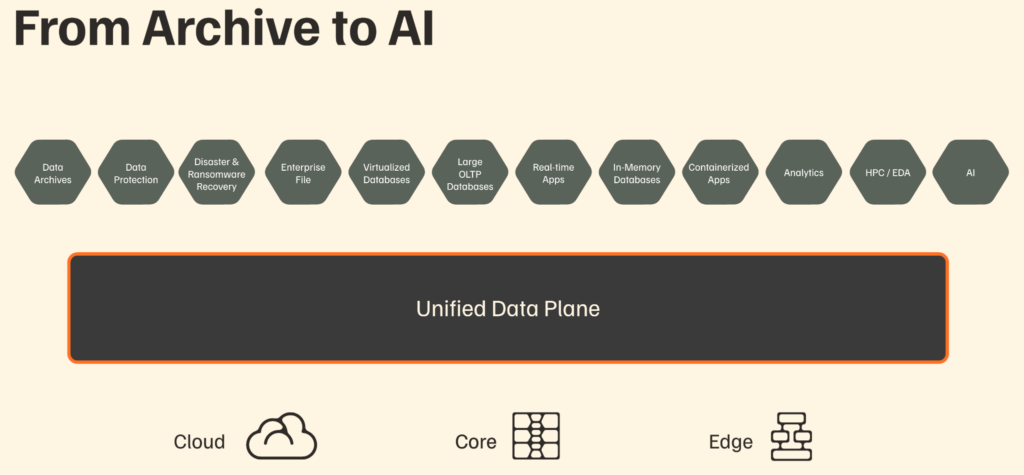
Figure 1: The Unified Data Plane delivers one foundation for all workloads, from archive to AI, wherever they live.
Higher performance and efficiency
Performance and efficiency have never mattered more, because the pressure is coming from every direction at once. AI is pushing workloads past what most infrastructure was sized for. Supply chain constraints and rising prices make it harder to just buy your way out. And data sovereignty rules and the shift in modern virtualization are pushing teams to consolidate rather than sprawl. All of it points to the same need: getting more out of the footprint you already own, and running your most demanding workloads on it. That’s what this year’s innovations are built to do.
Continue consolidating aggressively and still meet your SLAs
FlashArray//XL190 is the most powerful member of the FlashArray™ family, built to consolidate your broadest range of mission-critical workloads, including databases, virtualization, analytics, and AI, onto a single, resilient platform. But the hard part of consolidation has never been performance; it is uncertainty. No capacity plan survives contact with a real production environment, where backups, analytics, and AI workloads rarely arrive on the schedule you planned for.
The new Purity Turbo, delivered as a software upgrade, provides additional operational headroom to absorb that variability as it happens, allowing production workloads to continue uninterrupted. Instead of sizing every deployment around the worst case, organizations can consolidate with confidence, preserve application responsiveness, and consistently meet SLAs under pressure.
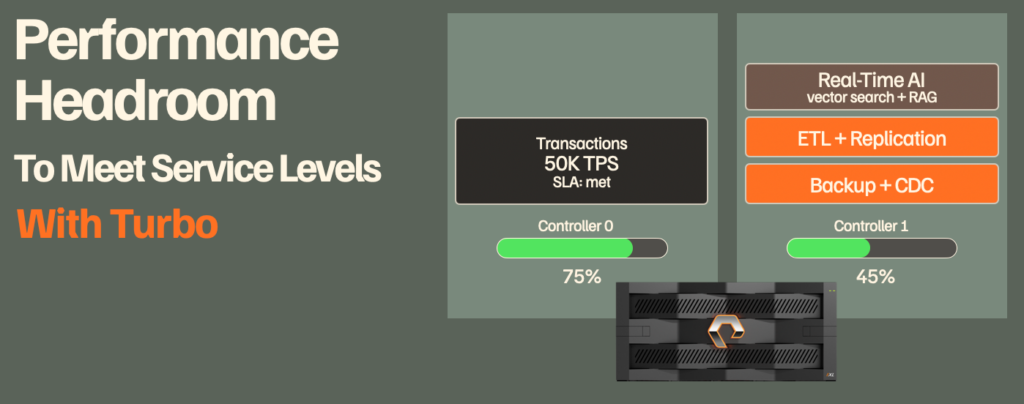
Figure 2: FlashArray//XL190 with Purity Turbo consolidates workloads, unlocking SLA headroom.
Burst past your SLA when you need to, and pay only for what you use
Hardware is only half the story, because most customers don’t buy Everpure as a box anymore. They consume it as a service through Evergreen//One™, the subscription that delivers storage as a service with always-modern hardware, non-disruptive upgrades, and capacity that grows with you. With this latest update, Evergreen//One gives you even more flexibility than ever before.
Evergreen//One Overdrive takes our proven capacity-on-demand model and extends it to performance. Every subscription includes a built-in performance buffer and when workloads push beyond that, Overdrive activates for that calendar day and you pay once for the full 24-hour window—no renegotiation or emergency procurements necessary. It’s one subscription that flexes based on how much data you hold and how hard you push it.
Nowhere does the efficiency pressure you’re facing show up faster than AI. Here’s what the Unified Data Plane looks like when AI enters the picture.

Figure 3: Evergreen//One Overdrive delivers performance on demand.
The fastest AI storage on the market
As AI spreads across the organization, the reflex is to stand up dedicated storage for each new team, model, and project. That’s how you end up back in silos, the exact pattern the Unified Data Plane is built to retire. FlashBlade//EXA™ lets you consolidate those workloads onto a single system. Usually, consolidation means trading away speed—not here. FlashBlade//EXA topped SPECstorage, the most demanding measure of AI storage, and sustains 616,129MB/s while running more than 7,200 AI jobs at the same time on one system. That headroom means no matter how many teams pile on, FlashBlade//EXA feeds the most data-hungry training and inference without slowing down.
Built-in multi-tenancy, quality-of-service, and security controls give every team and every model its own isolation and its own guarantees, so they can run side by side on one platform for file and object data without contending for resources or stepping on each other.
Get more usable capacity from the footprint you already own
All of that AI data has to live somewhere, and as your footprint grows, it competes for the same capacity as your other workloads. Efficiency is what keeps that growth from turning into constant cost overruns.
Purity DeepReduce™ on FlashBlade® applies intelligent data reduction to fit more into every terabyte, at any scale and without giving up performance. Growth no longer forces you to buy more hardware, and the efficiency you get keeps improving over time.
Together, these innovations do two things at once: They make your existing footprint more efficient, and they make room for AI on systems you already run. You get the headroom to hold SLAs, the flexibility to pay for what you use, and what you need for your biggest and boldest AI initiatives. All without buying your way out of every spike or standing up a separate stack to get there.
Increased workload depth
A broader foundation only matters if it covers all the workloads you run, however you run them. The Unified Data Plane turns different workloads from separate infrastructure conversations into one customer outcome: resilient, governable data with fewer tools, fewer copies, and less operational drag. In short: We’re delivering the same first-class services you love from FlashArray for block workloads to both file and object.
Keep critical file workloads always on
ActiveCluster™ for file brings continuous, zero-data-loss availability to your file workloads, with synchronous replication across arrays and automatic failover. Unlike legacy array-locked solutions, it delivers more granular failover and continuous access. This ensures a seamless user experience, with no manual remounts or recovery.
Make object storage enterprise-grade everywhere
Object is the common data layer for modern apps and AI across edge, core, and cloud, so it has to behave like enterprise storage everywhere it runs. Object notifications let systems react to object events the moment data changes, with event selection and prefix/suffix filtering that forward only the events that matter to targets like Kafka using AWS-compatible schemas. Instead of repeatedly scanning buckets or stitching together custom orchestration, a change in the data triggers the next step on its own—downstream processing, analytics pipelines, operational actions—with the audit trails, retries, buffering, and at-least-once delivery that automation, monitoring, and governance depend on.
Tagging turns a bucket into a searchable, governable catalog, so users can find and filter objects, track lineage and ownership, apply policy-based retention and metadata-driven deletion, and feed clean data sets to AI and analytics without manual prep.
Lifecycle policies and strong consistency round it out, automatically tiering objects and ensuring every read returns the latest write.
All of these capabilities are available from edge to core to cloud with the Intelligent Control Plane.
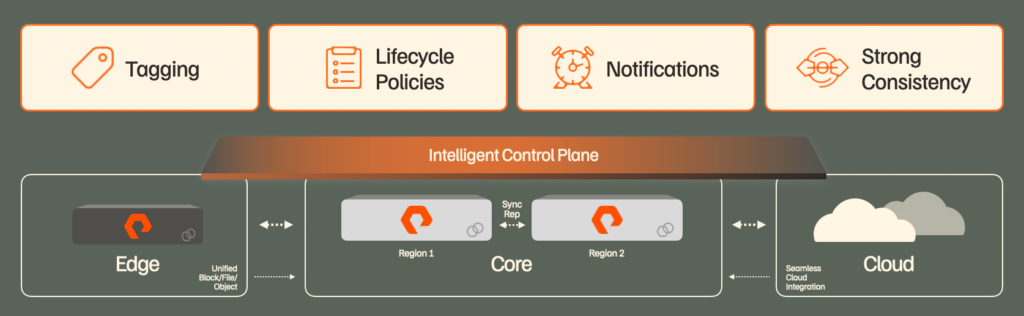
Figure 4: The Intelligent Control Plane brings enterprise-grade object services to edge, core, and cloud, with notifications, tagging, lifecycle, and strong consistency built in.
Once object behaves this way everywhere, the next question is how to run it at scale across multiple customers.
Scale multi-tenancy without losing isolation or resilience
Object multi-tenancy lets service providers and large enterprises consolidate onto shared infrastructure without compromising tenant boundaries, running many tenants on one estate while keeping each isolated. It brings Purity data protection to multi-tenant object workloads—a full suite of synchronous, near-synchronous, and asynchronous replication that meets each tenant’s RPOs and RTOs, with administrators able to trigger failover within their own realms. The result is consolidation without compromise: more tenants per footprint, resilience tuned to each, and isolation that holds.
Switch hypervisors without giving up your data services
File and object are only part of the picture. The bigger shift is in virtualization, where customers are rethinking their stack and weighing four credible paths:
- Stay with VMware
- Switch hypervisors
- Move to the cloud
- Modernize on Kubernetes
Our job isn’t to pick the path for you. It’s to give you the same industry-leading Everpure experience on whichever ones you choose.
For customers taking the switch path, deeper FlashArray integration with Nutanix lets you migrate vVol workloads with their data services intact, reclaim efficiency through change-block-tracking offload at the array layer, and manage FlashArray directly from Prism, keeping the strengths your admins count on, like non-disruptive upgrades, data reduction, and SafeMode, right inside the Nutanix console.
Modernize on Kubernetes, all the way to the edge
For customers focused on modernization, Portworx® now supports Kubernetes clusters running on KubeVirt VMs for stronger tenant isolation and compliance. Additionally, Kube Datastore provides data abstraction familiar to VMware teams and Portworx extends the same data management to the small clusters running in retail stores, factories, hospitals, and telco sites with Portworx Edge, so core and edge run on one platform.
Add it up and the foundation covers the workloads you run today and the ones you’re moving to—file, object, virtual machines, and containers—without asking you to stand up a separate system for each. Whatever form your workloads take, and wherever you decide to run them, they sit on the same data plane with the same protection, the same efficiency, and the same way of working.
Expanded cloud reach
For customers whose path forward runs through the public cloud, hybrid shouldn’t mean running two different architectures and hoping they meet in the middle. The Unified Data Plane now reaches natively into Azure, so you can place each workload where it makes the most sense, weighing sovereignty, latency, and cost against each other, with the same data services you run in the core.
Lower cloud storage costs without compromising performance
Everpure Cloud Azure Native for Azure Virtual Machines (VMs), generally available in July, enables you to provision, manage, and attach enterprise-grade block storage volumes directly to Azure VM workloads through native Azure experiences. Leverage consumption-based pricing to reduce cloud storage costs by up to 40% while paying only for the storage you use. By jointly engineering this solution with Microsoft, we’re helping you optimize costs and simplify operations for business-critical workloads.
Bring the Azure operating model into your own data center
FlashArray support for Azure Local scales to 64 Azure Local nodes, well past the 16-node ceiling of native HCI, so storage and compute scale independently. You run VMware and Hyper-V side by side on one array and keep Everpure data services in a sovereign, in-country, Azure-managed landing zone.
Either way, the cloud stops being a separate world. The same data plane, data services, and economics reach into Azure and back into your data center, so you choose where each workload runs instead of letting the architecture decide for you.
One foundation doing the work of many
For decades, the application was the center of gravity. Every app created its own data, kept its own copy, and built its own silo. That model defined the enterprise. AI breaks it.
The Unified Data Plane ends the silo era. Your data lives on one foundation across on-prem, cloud, and edge—accessed, protected, and operated as a single architecture instead of a hundred separate ones. This is not a better way to manage storage. It’s a different center of gravity—the data itself—and the foundation your business and your AI will be built on.
The Unified Data Plane stores all of it. The Intelligent Control Plane governs it. Universal data intelligence makes sense of it. To see how the rest of the architecture comes together, read the companion posts on the Intelligent Control Plane and universal data intelligence.