Why Modern Data Needs a New Reduction Model
This is the second post in our series on rethinking storage efficiency posture in the age of modern data. In the first post in this series, “Rethinking Enterprise Data Reduction for the AI Era,” we looked at the evolution of data growth and the need for a new approach.
In this installment, we dive deeper into why conventional data reduction techniques don’t fit the bill.
Where conventional approaches fall short
Most enterprise data reduction frameworks were designed in an era dominated by structured data, virtual machine images, and repetitive and aligned data sets. These legacy models rely primarily on:
- Block-level deduplication
- Fixed or variable window matching
- Fingerprint indexing
- Inline-heavy reduction strategies
These approaches work well when redundancy is clean and aligned.
But as data sets diversify and scale into multi-petabyte namespaces, structural limitations become visible:
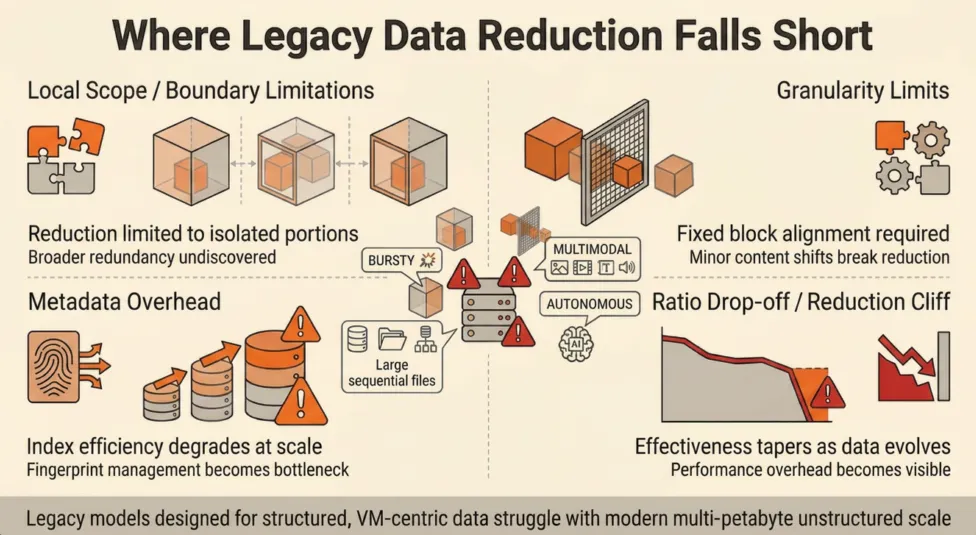
Figure 1: Limitations of legacy data reduction for modern data.
- Reduction depends on boundaries: Many systems limit efficiency to isolated portions of the environment (localized scoping), leaving broader redundancy undiscovered.
- Efficiency becomes less predictable as data evolves: As data sets diversify and grow, reduction effectiveness can taper—sometimes sharply—and performance overhead becomes more visible.
As unstructured data dominates enterprise environments, these limitations become unavoidable at multi-petabyte scale.

Figure 2: Legacy data reduction effectiveness declines as data sets evolve.
As unstructured data dominates enterprise environments, these limitations become unavoidable at multi-petabyte scale. Enterprises don’t just need high reduction ratios in ideal conditions—they need predictable reduction at scale. And as flash supply tightens and pricing volatility returns, storage efficiency moves from optimization to risk mitigation.
Enterprises cannot afford efficiency models that fluctuate as capacity grows. They need reduction that holds—because when media costs rise, predictability becomes strategic.
How traditional architectures behave at scale
Most traditional data reduction systems rely on fingerprint-based deduplication. At its core, deduplication depends on exact matches. Data is divided into blocks, each block is fingerprinted, and those fingerprints are compared against stored fingerprints. If fingerprints match, duplicate blocks are replaced with references to a single stored instance.
At a small scale, this works well. In structured environments such as virtual machine images or repetitive data sets, block alignment is predictable and duplicate detection is efficient. But as environments scale into multi-petabyte, unstructured namespaces and design boundaries begin to surface.

Figure 3: Issues that arise when using traditional deduplication at scale.
Boundary alignment
Deduplication requires block alignment. Fingerprints only match when blocks are boundary-aligned. Even small shifts in content, like inserting or removing data near the beginning of a file, can invalidate duplicate detection across entire data sets. Redundancy may still exist, but it becomes invisible to the algorithm.
Fingerprint index constraints
Deduplication systems cannot maintain fingerprints for every stored block. Indexes must be selectively cached and managed. As namespaces expand, index efficiency can degrade. This introduces the risk of tapering effectiveness, sometimes abruptly, when capacity exceeds the system’s effective index representation. The result can be a “data reduction cliff.”
Scoped reduction domains
Many enterprise platforms further limit reduction discovery by operating within scoped domains:
- Per aggregate (e.g., all flash and/or hybrid appliances)
- Per node pool (common in scale-out NAS architectures)
- Per ingestion path (backup-integrated models)
In these models, redundancy that crosses administrative boundaries often goes undiscovered and unexploited. Even variable-window deduplication techniques can only partially mitigate these constraints, as they still rely on alignment assumptions and index representation limits.
Ingestion-tier dependency
Some similarity-based engines depend on staging tiers or cache layers. This introduces a different limitation: Data that remains in certain layers or bypasses ingestion paths may not be consistently reduced.
These design decisions were reasonable in structured, VM-centric environments. In today’s AI era, they’re architecturally insufficient for multi-petabyte, unstructured scale. Enterprise-scale reduction requires metadata architectures that scale with capacity, not ones that introduce new coordination bottlenecks as clusters grow.
The evolution of efficiency at Everpure
Purity DeepReduceTM is not a reinvention driven by market trends or competitive claims. It is the latest step in a long evolution of data reduction innovation at Everpure.
From the earliest days of all-flash storage, efficiency has been foundational to Everpure strategy. Delivering an “all-flash solution” required industry-leading data reduction as an architectural discipline—not simply as a feature.Efficiency at Everpure is not limited to software-level data reduction. It begins at the NAND layer. Most enterprise all-flash systems are built on commodity SSDs—inheriting per-drive controllers, embedded flash translation layers (FTLs), and overprovisioning optimized for server use. In contrast, Everpure™ DirectFlash® architecture was designed specifically for flash from the ground up. DirectFlash Modules (DFMs) expose raw NAND directly to Purity, enabling system-level media management across the entire pool of flash rather than isolated, per-drive control. By eliminating redundant controllers and embedded FTLs, reducing overprovisioning overhead, and optimizing data placement globally, Everpure delivers significantly higher usable capacity per TB of NAND.
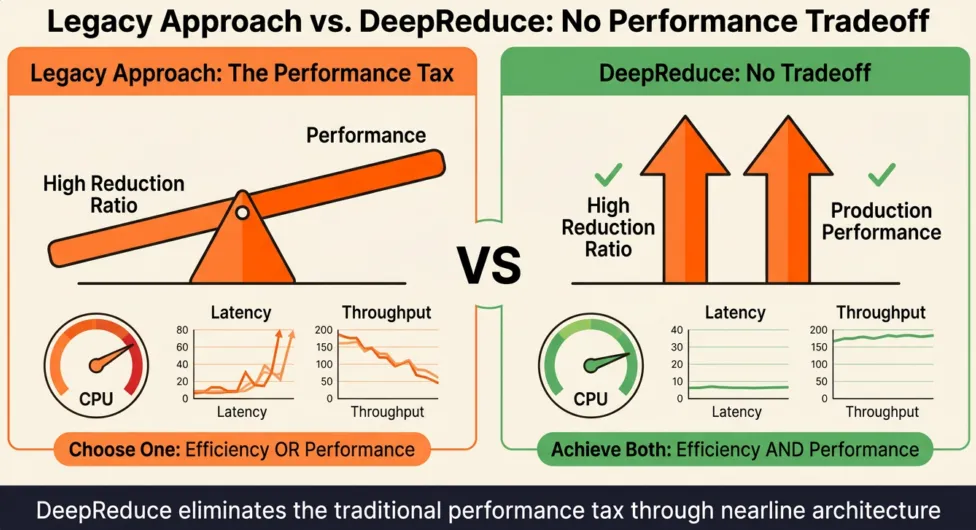
Figure 4: Comparison of legacy data reduction performance tradeoffs to Purity DeepReduce.
In practical terms, this means more effective capacity from the same raw flash, fewer modules required to reach a target usable footprint, and improved TB per watt. When combined with Purity DeepReduce similarity-based data reduction, this NAND-level efficiency compounds—delivering materially higher effective capacity per TB of flash compared to SSD-based architectures, particularly in large-scale and retention-heavy environments.
On the software front, as data shifted from structured, human-managed systems to multimodal, AI-driven and autonomous workloads, reduction models evolved as well: fixed blocks, variable matching, sliding windows—and now similarity-based reduction.
Efficiency at Everpure has never been static. Each generation builds on the last—compounding value across the platform while preserving predictability. Purity DeepReduce represents that evolution—extending Everpure leadership in storage efficiency into the era of multi-petabyte unstructured data.
It is not a reaction.
It is the next architectural milestone.
In our next blog, we’ll take a closer look at Purity DeepReduce and how it’s going to redefine data reduction to the core of today’s data framework.