Summary
The new FlashStack with VMware vSphere Foundation 9.1 Cisco Validated Design delivers a flexible architecture that helps organizations modernize virtualized workloads, simplify operations, strengthen security, and keep future hypervisor choices open.
This blog was co-authored with Chris O’Brien, Senior Technical Marketing Director, and Gopu Narasimha Reddy, Technical Marketing Engineer, at Cisco Systems, Inc.
For many organizations, infrastructure modernization is not about replacing everything at once. It’s about improving performance, security, and operational efficiency while protecting existing investments and preserving the freedom to make future platform decisions.
That is the customer story behind the new FlashStack® with VMware vSphere Foundation 9.1 Cisco Validated Design (CVD). Developed through deep collaboration between Cisco and Everpure, the CVD brings together Cisco UCS compute, Cisco Nexus and MDS networking, Everpure™ FlashArray™ storage, and VMware vSphere Foundation (VVF) 9.1 in a validated, repeatable architecture.
This work reflects the contribution of Gopu Narasimha Reddy, Technical Marketing Engineer at Cisco, and Gaurav Nigam, Senior Solutions Architect at Everpure. Their collaboration brings together solution architecture, customer perspective, and technical marketing discipline—ensuring the release is understood not only as a collection of features, but as a practical platform for customer outcomes.
What VVF 9.1 means for customers
VVF 9.1 is an important step in modernizing the virtual infrastructure layer. The associated requirements and technical design documents position it as an enterprise workload platform that brings cloud-inspired operational efficiency to on-premises environments, while supporting virtual machines, containers, and accelerated workloads.
The CVD highlights capabilities that can make a measurable difference in day-to-day operations:
- Native NVMe memory tiering, which can extend available memory capacity using local NVMe devices and help consolidate more workloads on existing compute resources
- GPU virtualization, allowing GPU resources to be shared across guest virtual machines for AI, machine learning, visualization, and other accelerated workloads
- Confidential computing, including TPM and vTPM support, vSphere Trust Authority integration, runtime memory encryption with AMD SEV-SNP, and storage encryption for data at rest
- Integrated lifecycle management through Cisco Intersight and vSphere Lifecycle Manager—helping teams maintain consistent Infrastructure firmware and software configurations
- Pure1® and VCF Operations provide VVF with end-to-end visibility and day-two operational intelligence across VMware workloads and Everpure, helping teams monitor health, troubleshoot faster, manage capacity, and optimize performance with greater simplicity and confidence
- A foundation for modern application patterns, including the vSphere Kubernetes Service and other capabilities designed to support traditional and cloud-native workloads
These features matter because they address practical infrastructure pressures: increasing workload density, the need for stronger workload protection, growing GPU demand, and the operational cost of managing complex environments manually.
A validated design reduces deployment risk
The value of a Cisco Validated Design is not simply that the individual components are compatible. It’s that the architecture, configuration approach, and operational model have been brought together and documented as a complete solution.
The FlashStack VVF 9.1 design covers Cisco UCS X-Series and C-Series compute, Cisco Nexus Ethernet switching, Cisco MDS Fibre Channel connectivity, and Everpure FlashArray storage. It validates both IP-based and Fibre Channel-based deployment patterns, including:
Ethernet
- Boot from SAN using iSCSI
- iSCSI
- NVMe over TCP (NVMe/TCP)
- NFS
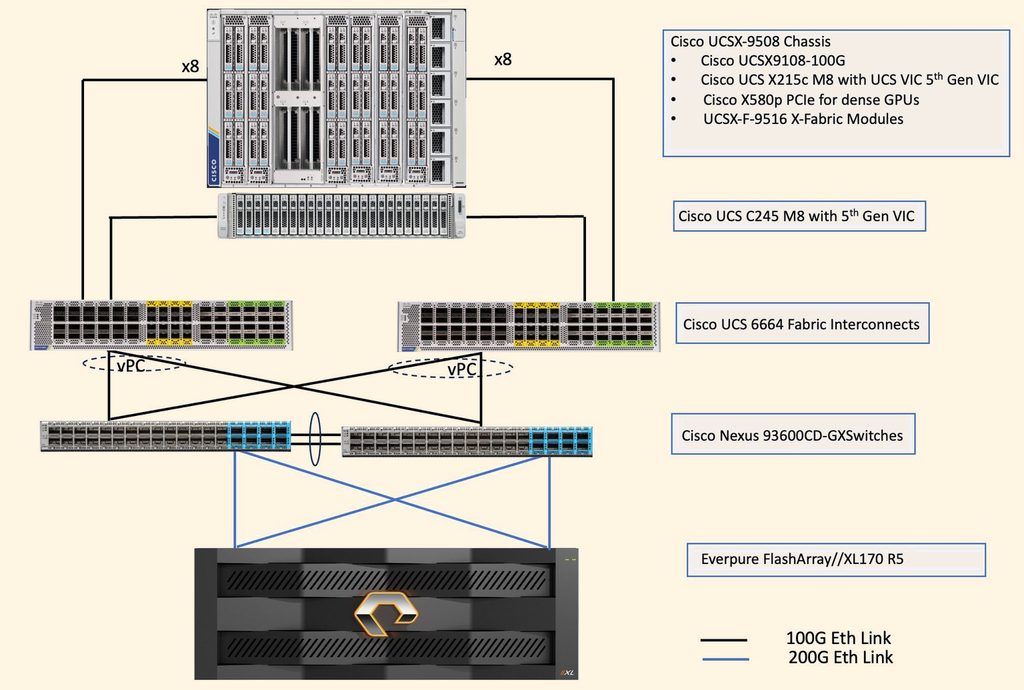
Figure 1: FlashStack with VMware vSphere Foundation 9.1 CVD Ethernet topology.
Fibre Channel
- Boot from SAN using Fibre Channel
- Fibre Channel
- NVMe over Fibre Channel (NVMe/FC)

Figure 2: FlashStack with VMware vSphere Foundation 9.1 CVD Fibre Channel topology
This gives customers room to align the design with their existing skills and operating model. Organizations standardizing on Ethernet and NVMe/TCP can follow an IP-based path. Those with deep Fibre Channel expertise can continue to use that model while adopting newer NVMe capabilities. The architecture is designed to make either approach more repeatable and supportable.
The technical requirements also emphasize resilience: redundant connectivity, a loop-free network topology, fast convergence after link failures, and the ability to continue operating through failures of individual network components or storage controllers. These design features elevate a standard reference architecture into an enterprise-ready platform that organizations can confidently rely on for critical production workloads.
Simpler operations across the stack
Customers also need modernization to reduce operational overhead, not add another layer of complexity. FlashStack addresses this through integrated management across compute, networking, storage, and virtualization.
Cisco Intersight Infrastructure Services and Intersight IMM provide centralized management for the UCS environment, including policy-based configuration and lifecycle operations. Everpure Pure1 adds cloud-based monitoring, predictive insights, VM analytics, and visibility across FlashArray environments. The Everpure vSphere plugin enables administrators to provision storage and perform common storage operations from within vCenter.
Highlighted capability: VM-aware protection from VMware vCenter
A standout FlashArray–VMware capability in the CVD is VM-aware protection through the Everpure vSphere plugin, which enables administrators to create VM-aware snapshots and apply protection policies from vCenter. When array-based replication is used with VMware Live Site Recovery, the Everpure Storage Replication Adapter (SRA) provides the integration required to orchestrate failover, failback, and recovery workflows.
For customers, this means storage protection can be aligned with the way VMware teams already manage workloads: at the VM and datastore level, through a familiar interface, without requiring administrators to move between multiple management consoles for every protection task. It’s a practical example of how FlashArray and VMware work together to improve both day-one provisioning and day-two operations.
Integration of Intersight with vCenter is another standout capability. The integration unifies server hardware management directly within the vSphere Client by leveraging the Hardware Support Manager (HSM) alongside vSphere Lifecycle Manager (vLCM) to seamlessly update base OS images, drivers, and server firmware. Concurrently, it functions as a native VMware Proactive HA provider, continuously monitoring critical hardware components for impending faults. Upon detecting an anomaly, the plugin automatically alerts vCenter to place the degraded host into Quarantine or Maintenance Mode, triggering live vMotions to protect running virtual machines from unexpected downtime.
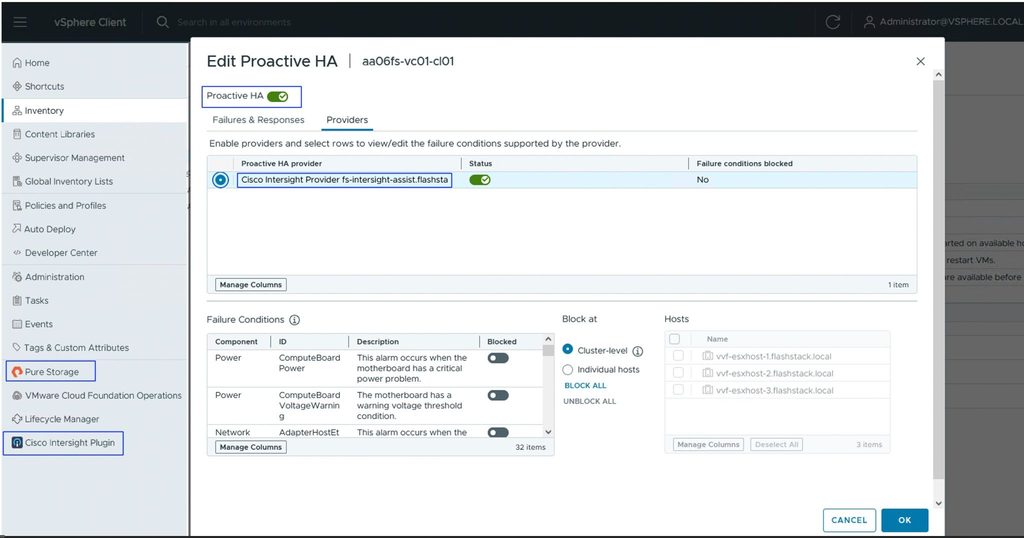
Figure 3: VMware vSphere Client with Cisco Intersight and Everpure (formerly Pure Storage) plugins.
This integrated approach helps teams move from manual, component-by-component administration toward a more consistent operating model. It also supports the customer value propositions identified for FlashStack: simpler deployment through pre-validation, efficient all-flash performance and density, modular scaling, lower ongoing operational overhead, and cloud-managed visibility and control.
The Everpure FlashArray Management Pack for VCF Operations enables VCF Operations to leverage health, capacity, and performance data from multiple FlashArray systems and their relevant vSphere resources. The management pack includes dashboards, alerts, and metrics that help to monitor the performance, capacity, and health of the Everpure resources with end-to-end centralized monitoring. This allows you to view and analyze performance and capacity statistics, monitor the health of the objects, determine risks, and generate reports.
Optionality is all part of the design
The VVF 9.1 CVD validates VMware vSphere Foundation, but it should not be interpreted as a one-platform mandate. Everpure and Cisco’s broader FlashStack approach is to preserve customer choice by separating compute and storage, validating complete solutions, and enabling customers to select the virtualization platform that best fits their workloads, commercial strategy, skills, and roadmap.
That includes CVD paths for VMware vSphere Foundation, Nutanix Cloud Infrastructure, and Red Hat OpenShift containerization and virtualization. Customers can adopt VCF 9.1 where it’s the right fit, while retaining the flexibility to evaluate other supported hypervisor options as business needs evolve. The compute, network, and storage foundations do not need to be redesigned every time the hypervisor conversation changes.
This is especially important in a market where customers are balancing licensing changes, application requirements, cloud strategies, and existing operational expertise. Optionality is not about delaying a decision. It’s about making the decision based on business and workload priorities rather than infrastructure constraints.
A foundation for the next decision
The most important message from FlashStack with VVF 9.1 is that modernization should expand customer options, not narrow them.
VVF 9.1 adds capabilities for memory efficiency, automation, Kubernetes, GPU-enabled workloads, confidential computing, and lifecycle management. FlashStack adds a validated architecture with flexible storage protocols, independent scaling, integrated management, and a documented path to repeatable deployment.
Together, they give customers a practical way to modernize now while preserving the freedom to make future hypervisor choices on their own terms. That is the role of a strong validated design: not to prescribe one permanent answer, but to make the right answer easier to deploy, operate, and change over time.
Explore the FlashStack VVF 9.1 Design
Review the validated Cisco and Everpure architecture for scalable VMware workloads, AI readiness, simplified operations, and future flexibility.