
Summary
Everpure FlashBlade accelerates Oracle and SQL Server backup and recovery, protecting these mission-critical databases at scale with restore speeds that match backup rates.


When a mission-critical database goes down, the conversation shifts fast. Nobody asks about backup windows or storage efficiency. They ask one question: How long until we’re back online?
For Oracle and SQL Server environments, the answer depends on infrastructure that most organizations take for granted until it fails them. Backups complete on schedule, compliance boxes get checked, and everyone assumes recovery will work when needed. Then an incident occurs, and a restore takes all day.
The cost of that gap isn’t theoretical. A 12-hour restore against a 4-hour RTO means extended outages cascading through dependent systems, SLA breaches triggering penalty clauses, and the painful reality of post-incident revalidation before anyone trusts the data again. Business continuity plans don’t survive contact with slow recovery.
This gap between backup success and recovery reality is where risk lives. We set out to close it.
Backup Appliances Optimize for the Wrong Thing
Purpose-built backup appliances (PBBAs) optimize for getting backup data onto disk as efficiently as possible. Deduplication shrinks storage footprint. Compression reduces network load. The backup window closes on schedule.
But these optimizations create a hidden debt that comes due at the worst possible moment. Data that was deduplicated on ingest must be rehydrated on recovery. Compression that reduces time during backup adds latency during restore. The architecture that makes backup efficient makes recovery slow.
The result is unpredictable restore times that make RTO commitments meaningless, DR tests that fail or get quietly skipped, and outages that run hours longer than anyone planned for. When the CFO asks why the ERP system was down for 16 hours instead of 4, “the backup worked fine” isn’t an answer.
The Problem Scales with the Database Size
Enterprise database estates face compounding pressure. According to the 2023 Quest Oracle Community Database Priorities Survey, 28% of Oracle environments now manage databases exceeding 25TB, with the 5-25TB range becoming the norm for mission-critical systems. SQL Server estates present a different challenge: not necessarily fewer large databases, but many concurrent instances requiring parallel backup and recovery operations. Both patterns strain traditional backup infrastructure in different ways.
A 25TB database needs over 6TB/hour throughput just to complete a full backup in four hours. At 50TB, that doubles. Many backup appliances cannot sustain these rates for backup, let alone for restore.
What If Storage Wasn’t the Bottleneck?
We validated Everpure FlashBlade® as backup targets for Oracle RMAN and SQL Server native backup, using the tools DBAs already know and trust. No proprietary agents, no intermediate appliances, no lock-in to specific backup formats. RMAN writes to NFS. T-SQL writes to SMB or S3. The storage does the rest.
This approach extends to enterprise backup software as well. For environments using Commvault, Veeam, or similar solutions, FlashBlade and FlashArray serve as high-performance targets while preserving existing workflows and policies.
The key difference from PBBAs is that this solution delivers symmetric read/write performance. Data reduction happens inline without creating a rehydration penalty on read, so restore runs as fast as backup.
How We Validated This
We ran extensive validation across both database platforms, multiple storage configurations, and workloads reflecting how customers actually deploy these systems.
- For Oracle databases: We tested RMAN backup and restore using Direct NFS (dNFS) to FlashBlade. Oracle environments typically consolidate into fewer, larger databases, so we focused on maximizing single-database throughput. Configurations included standalone instances and two-node RAC clusters, with a single database of 10TB in size.
- For SQL Server: We tested native T-SQL backup and restore of a 1TB database to SMB file shares and S3 object storage on FlashBlade. SQL Server estates tend toward many concurrent instances, so we validated both single-instance performance and aggregate throughput across eight instances concurrently.
All throughput figures represent real time to backup or restore, measured as database size divided by operation duration. These aren’t peak numbers or synthetic benchmarks. They reflect actual time to protect or recover production data.

Figure 1: 2-Node RAC Cluster Restore Performance
Oracle RMAN achieved over 60TB/hour restore throughput on FlashBlade using distributed RAC channels, which means a 10TB database recovered in approximately 10 minutes.
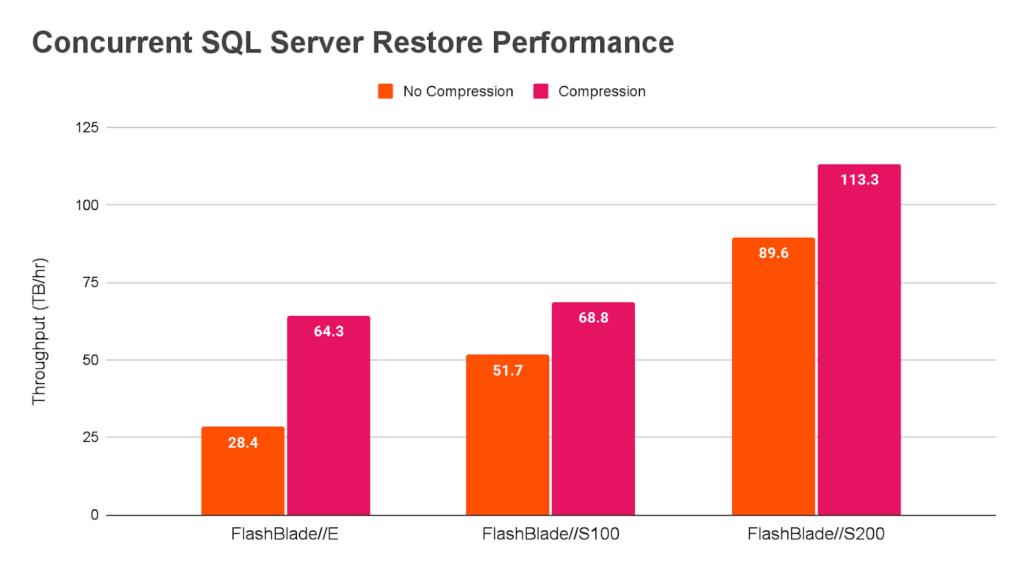
Figure 2: Concurrent SQL Server Restore Performance
SQL Server achieved over 113TB/hour restore throughput on FlashBlade across eight concurrent instances with compression enabled, and over 89TB/hour with compression disabled.
Restore runs as fast as backup, which isn’t how this usually works. Most backup infrastructure trades write efficiency for read speed, so recovery always takes longer than anyone planned.
The Spectrum of Data Protection
Not every database has the same recovery requirements. Everpure covers the range:
- Massive throughput: Over 113TB/hour restore for SQL Server, 60TB/hour for Oracle RMAN. A 10TB database recovers in approximately 10 minutes.
- Scale-out architecture: Performance grows as you add capacity. Consolidating more databases onto the platform doesn’t degrade recovery times for existing workloads.
- Native database tooling: RMAN writes to NFS via dNFS. T-SQL writes to SMB or S3. No proprietary agents, no separate backup catalog to manage.
- Immutable recovery points: SafeMode™ Snapshots protect against ransomware and accidental deletion with multi-party authorization and mandatory waiting periods.
- Multi-site resilience: Replication to a secondary FlashBlade, FlashArray, or S3-compatible cloud storage extends protection beyond a single site.
FlashBlade is part of the Everpure Enterprise Data Cloud, where the goal is managing data, not storage. The same platform that protects your mission-critical databases integrates into a unified control plane with policy-driven governance, consistent operations across your estate, and no array-by-array management overhead. Database protection becomes part of your data strategy, not a separate silo to maintain.
The technical white papers below provide detailed guidance for sizing and configuration based on workload requirements:
- Fast Backup and Recovery for SQL Server at Scale with FlashBlade
- Meeting Oracle Recovery SLAs at Enterprise Scale with FlashBlade
Protecting mission-critical databases shouldn’t require choosing between backup windows, recovery SLAs, and operational simplicity. With restore speeds that match backup rates and immutable snapshots that survive ransomware, that’s a choice you don’t have to make.Want to prove this value for yourself? Test drive FlashBlade today.
Validate Your Recovery at Scale
See the full test methodology, throughput benchmarks, and configuration guidance for protecting large SQL Server estates with FlashBlade.