Summary
Everpure gives VMware Cloud Foundation 9.1 the agile data foundation it needs to run a modern private cloud with scalable storage; lower infrastructure costs; built-in cyber resilience; and unified support for VMs, Kubernetes, and AI workloads.


As enterprises reevaluate their infrastructure strategy, VMware Cloud Foundation (VCF) 9.1 has emerged as Broadcom’s answer for the modern private cloud. It unites compute, networking, storage, automation, operations, security, Kubernetes, and AI-ready services under a consistent operating model. Broadcom’s VCF strategy is transforming VMware from a disconnected virtualization stack into a true integrated modern private cloud platform.
However, a private cloud is only as valuable as the data platform behind it. VCF provides the modern private cloud operating model, but an Everpure Enterprise Data Cloud (EDC) provides the vital data foundation that brings it to life.
Here’s how Everpure helps customers realize the full value of VCF 9.1 across the workloads that matter most.
A complete data platform for every workload
Today’s enterprise IT departments are essentially running two different companies at once. On one side, you have the business-critical applications that keep the lights on. On the other hand, they’re being aggressively pushed to build the future—deploy cloud-native applications, stand up AI initiatives, and defend against sophisticated cyber threats. Trying to support these wildly diverse data profiles on fragmented infrastructure creates massive operational complexity and deep data silos, driving up costs and slowing down innovation.
VMware Cloud Foundation (VCF) 9.1 addresses this head-on by moving past the era of the simple hypervisor. VCF is the ultimate enterprise cloud, transforming what used to be a disconnected virtualization stack into a unified private cloud platform. It brings vSphere, NSX, VMware Live Cyber Recovery, and IaaS-based automation together so enterprises can run VMs, containers, and AI services under one consistent, streamlined operating model.
However, a unified operating model requires a data foundation agile enough to match its ambition. That’s where Everpure comes in. Through Everpure™ FlashArray™, FlashBlade®, Portworx®, and Everpure Cloud, Everpure delivers a comprehensive data platform engineered for the entire enterprise, addressing the needs of block, file, object, and Kubernetes workloads.
Crucially, Everpure Fusion™ serves as the common management layer for this entire ecosystem. Just as VCF unifies your infrastructure management, Everpure Fusion unifies your data environment, actively breaking down traditional data silos across your diverse workloads. Whether you’re running legacy databases, orchestrating containerized microservices, scaling private AI, or orchestrating a rapid recovery from a ransomware attack, Everpure Fusion ensures your data is just as flexible, automated, and high-performing as the VCF platform itself.
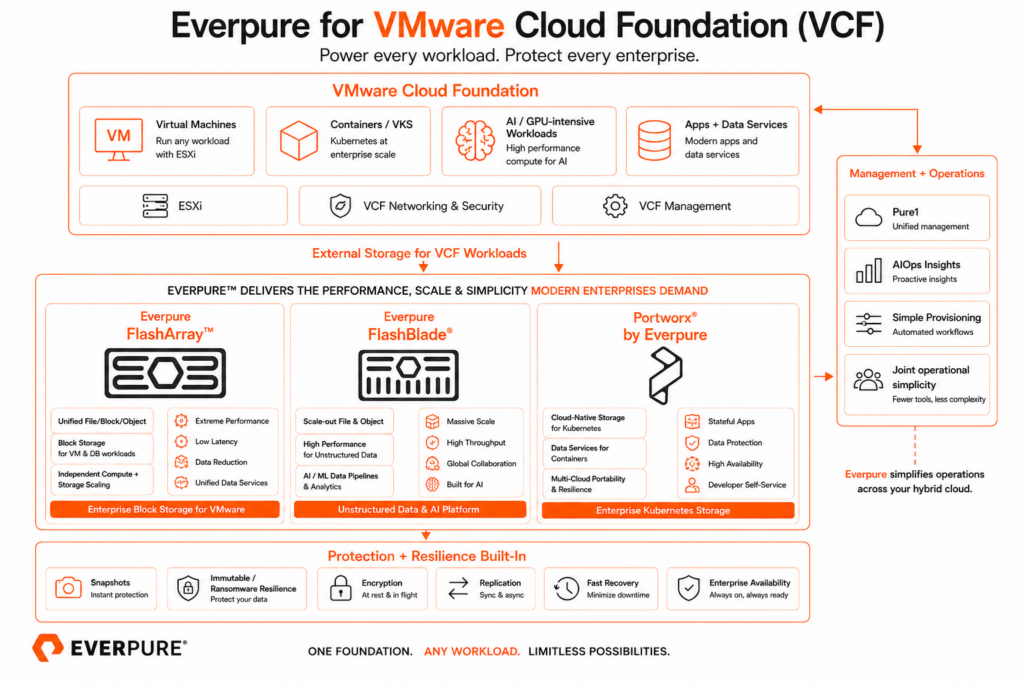
Figure 1: Everpure delivers a complete foundational layer to VMware Cloud Foundation. In addition to delivering high-performance storage, Everpure provides management, data resiliency, observability, and more.
Optimizing infrastructure economics and scaling flexibility
With Broadcom’s transition to a core-based licensing model in VCF 9.1, every server core you deploy carries a direct licensing cost. This makes traditional hyperconverged infrastructure (HCI) an economic trap for data-heavy enterprises. Because HCI scales compute and storage linearly in a single box, a surge in data growth forces you to buy more server nodes just to get more data capacity, which inflates your VCF core licensing bill. Furthermore, because HCI relies heavily on the network to replicate and acknowledge multiple copies of data, it puts a massive strain on network infrastructure, choking performance for your most critical workloads.
This data explosion is only getting started. It is not just about storage to boot your VMs. Massive growth continues to come from unstructured data use cases. This covers both traditional file use cases and expansive demands from containerized applications and AI use cases. These demand significant and bursty levels of capacity and performance scale.
VCF 9.1 is engineered to break this one-size-fits-all mold by introducing true architectural choice into the private cloud. Through Workload Domains, VCF allows organizations to build separate, optimized infrastructure pools dedicated to specific application profiles. Additionally, VCF natively supports a variety of principal storage options—including high-performance NVMe over Fabrics (NVMe-oF), Fibre Channel, and NFS. This architectural flexibility allows enterprises to match the storage protocol to the workload’s actual needs, maximizing hardware utilization, which is crucial in the current supply constraint environment.
Everpure unlocks this true economic promise of VCF by cleanly decoupling compute from storage. Instead of being locked into rigid, expensive HCI scaling, Everpure allows you to expand your data layer independently. If your data grows, you add capacity through our seamless, non-disruptive upgrades—without buying unnecessary server nodes, triggering extra VCF core license fees, or getting bogged down by server supply chain delays. This is for both structured and unstructured data needs.
When you pair this independent scaling with Everpure industry-leading data reduction, thin provisioning, and performance sharing, you get unmatched data center density. Best of all, because Everpure handles resilience and performance natively at the data layer, it completely eliminates the network-choking replication overhead of HCI. This frees up your network infrastructure to do what it was meant to do: deliver blazing-fast performance to your VCF-hosted applications.
High-performance databases and automated lifecycle management
VCF 9.1 builds database lifecycle management into the platform itself through VMware Data Services Manager (DSM). That baseline is necessary, but it is not sufficient. The performance bottlenecks that slow down transaction times and stall application response during peak hours do not fail at the management layer. They happen by overwhelming the underlying storage with unpredictable, mixed read/write workloads that standard platforms cannot handle without massive compute overprovisioning. The data layer is the only thing that determines whether a business-critical database consistently meets its SLA or drops connections under load.
Everpure FlashArray brings a high-performance, low-latency data architecture to VCF 9.1 that assumes database workloads will constantly push infrastructure to its absolute limits. Sub-millisecond latency is delivered consistently across the heaviest transactional volumes, governed by a data engine that includes QoS performance sharing across multiple environments. Inline data reduction and thin provisioning are enabled natively within the FlashArray platform, closing the efficiency gap that has historically separated massive database sprawl from controlled capacity growth.
For relational databases like PostgreSQL, MySQL, or Microsoft SQL Server, the integration with VMware DSM pairs VCF’s policy-based compliance with the FlashArray system’s underlying block performance. Production environments refresh and recover at the speed of the array, not the speed of traditional host-based replication. The same optimized architecture extends through our validation across enterprise relational workloads, so the organization’s existing database administrator toolset remains the orchestration layer rather than the constraint.
The performance and efficiency capabilities live natively within the storage layer, which means capacity growth and database performance are decoupled from the VCF core licensing footprint. For transaction-heavy industries looking to maximize database density, that separation is the architectural answer to the CFO’s question of how to scale critical data footprints without exponentially increasing licensing costs.
Private AI pipelines and cloud-native execution
With AI becoming an imperative for organizations of all sizes, enterprise IT has been forced to live a double life. On one side, infrastructure teams run the core business on virtual machines. On the other, developers and data platform teams are sprinting ahead with Kubernetes to build modern applications and AI pipelines.
VMware Cloud Foundation 9.1 aims to tackle this operational divide head-on by embedding container orchestration natively through vSphere Kubernetes Service (VKS). The promise is incredibly compelling: give customers a single, consistent operating model to manage both VMs and containers under one roof. But as has become evident over the past couple of years, the friction that stalls modern application rollouts doesn’t happen because teams lack a shared management dashboard. It happens because transient containers and massive AI workloads have a radically different data DNA than legacy VMs. Forcing these conflicting data profiles onto a traditional siloed storage platform breaks the very agility VCF is trying to deliver.
Everpure brings the missing data architecture to VCF 9.1, making that single operating model a practical reality. Through Portworx Enterprise, Everpure gives VKS the automated, cloud-native storage layer that containerized microservices demand—handling Day 2 operations, instant snapshots, and disaster recovery seamlessly. Simultaneously, for the AI pipelines running inside those containers, Everpure FlashBlade® delivers a highly scalable file and object engine capable of pushing up to 20+ TB/s of blazing read performance. This ensures that modern apps and massive parallel data streams coexist on the same platform without fighting for resources or fracturing your private cloud back into isolated infrastructure silos.
Everpure native validation across the NVIDIA DGX ecosystem—spanning from 128 to 10,000 GPU nodes—ensures large-scale training and retrieval-augmented generation (RAG) execute at the true speed of the hardware. This isn’t theoretical; it’s backed by top marks in MLPerf 2.0 and SPECstorage testing. Because Everpure integrates natively across these open ecosystems, the customer’s preferred AI toolchains and Kubernetes distributions remain the accelerators of innovation, not the source of infrastructure complexity.
Layered security, sovereignty, and cyber resilience
VCF 9.1 builds security into the platform itself, from the hypervisor through the application layer. That baseline is necessary, but it is not sufficient. The attacks that took down hospital systems, financial institutions, and government agencies over the past two years did not fail at the hypervisor. They succeeded by walking past every control above the storage layer using stolen credentials and the organization’s own administrative tools. The storage layer was the only thing that determined whether the business recovered in minutes or weeks.
Everpure brings a layered resilience architecture to VCF 9.1 that assumes each layer above it has already failed. SafeMode™ Snapshots are immutable at the point of creation, governed by a control plane that lives outside the customer’s environment, so no compromised administrator credential can unilaterally delete a protected copy. Synchronous replication through ActiveCluster™ keeps a second site in lockstep for automatic site failover with zero data loss. Asynchronous replication carries data into isolated recovery environments and into Everpure Cloud for long-term retention and regional residency. SafeMode and replication are now enabled by default on new Everpure systems, closing the deployment gap that has separated rapid recovery from multi-day restore in real incidents.
For customers who standardize on Rubrik, the joint Rubrik Security Cloud and Everpure integration pairs Rubrik’s air-gapped vaults and threat analytics with Everpure immutable snapshots and the restore performance of the underlying array. Clean recovery points surface automatically, and critical VMware environments come back online at the speed of the array, not the speed of the backup appliance. The same layered architecture extends through our alliances with Commvault and Veeam, so the customer’s existing data protection investment remains the orchestration layer rather than the constraint.
Sovereignty follows the same pattern. The control plane that governs SafeMode lives outside the customer environment, which means data residency, key management, and recovery authority are decoupled from the workload itself. For regulated industries operating under DORA, NIS2, or sector-specific resilience mandates, that separation is the architectural answer to the regulator’s question of who can delete the recovery copy.
Unified operations and simpler management
As environments grow more complex, maintaining operational simplicity is critical. Everpure brings deep automation and consistent data services to the VCF environment. Through the Everpure vSphere Client Plugin, administrators can configure cluster access, provision datastores, and manage snapshots seamlessly from within vSphere. Combined with Pure1® visibility across on-premises, hybrid, and cloud-connected environments, IT teams can break down silos and manage their entire data estate through a single, intelligent pane of glass.
Users can dive deep into problem areas with Pure1 VM Analytics. This tool highlights the connected path from disk to VM to pinpoint performance bottlenecks to get to resolution faster. The Pure1 Virtualization Assessment generates custom reports to gain clarity into your VM utilization and uncover specific VCF license cost optimization strategies.
Modernize with confidence
The transition to VCF 9.1 is about building a modern private cloud that can confidently support the future of your business. VCF provides the operating model for that future. Everpure provides the data foundation that makes it real. Together, VCF and Everpure give enterprises a practical path to modernize their infrastructure while protecting the investments, skills, and applications they already rely on.
Ready to dive deeper? Learn more about Everpure solutions for VMware, and read our VMware Kubernetes Service validation with Portworx.
Ready to modernize your private cloud? Watch the video below to see how Everpure helps you simplify operations, support diverse workloads, and build a resilient data foundation for VMware Cloud Foundation 9.1.