Summary
FlashStack, a validated, full-stack architecture combining Everpure FlashArray and FlashBlade with Cisco UCS, Nexus, and MDS, is designed to power mission-critical workloads. Integration with Cisco Intersight offers unified, single-pane-of-glass management.


We’re excited to showcase the next chapter in the Everpure–Cisco partnership: the general availability of Everpure™ FlashBlade® integration into Cisco Intersight at Cisco Live Las Vegas.
This integration requires Cisco Intersight Advantage tier licensing and is available across all form factors including:
- SaaS: Offers cloud simplicity
- Cisco virtual appliance (CVA): For on-premises control
- Private virtual appliance (PVA): For highly secure private environments
For over 10 years, customers have trusted FlashStack®—a validated, full-stack architecture jointly engineered by Cisco and Everpure (formerly Pure Storage)—to power mission‑critical workloads.
FlashArray + Cisco Intersight: The foundation we’re building on
Many customers started their journey with FlashArray™ integration. Intersight already provides a rich, cloud‑hosted control plane for FlashArray—covering inventory, health, capacity, and day‑to‑day operational workflows.
From a single Intersight UI, you can discover FlashArray systems, view array‑level dashboards (hosts, volumes, snapshots, and protection groups), and use Intersight Cloud Orchestrator tasks to automate common storage operations.
That existing FlashArray integration is what makes FlashStack so powerful as a converged platform: Compute, network, and block storage are all visible—and automated—from one place. The new FlashBlade integration simply extends that same operational model to unified file and object workloads.
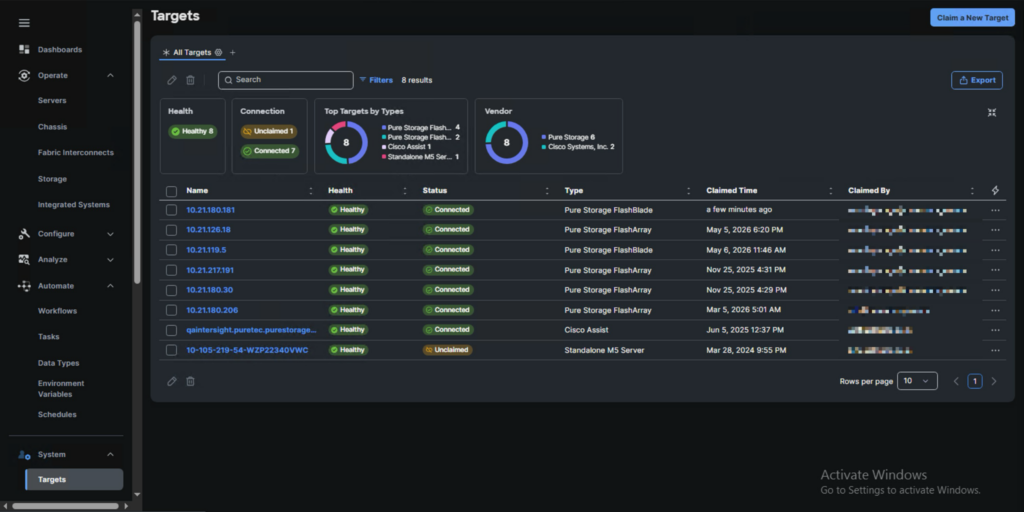
Figure 1: Cisco Intersight target list, including Everpure FlashArray and FlashBlade.
What’s new: FlashBlade inside Cisco Intersight
With this GA release, you can now discover and manage FlashBlade systems natively from Cisco Intersight, alongside your Cisco UCS compute and Nexus/MDS networking:
- Native FlashBlade onboarding: Claim FlashBlade targets into Intersight using secure API token-based authentication and associate them with existing infrastructure pods and policies.
- Rich inventory and topology: See detailed inventory across blades, drives, network interfaces, link aggregation groups, and chassis, mapped into Intersight’s storage object model for FlashBlade.
- Unified file and object view: Get a single, consistent view of FlashBlade filesystems and S3‑compatible object buckets—including capacity, data‑reduction, and object counts—alongside your existing FlashArray integration.
- Capacity and health at a glance: Surface key utilization and health metrics (virtual vs. physical space, data reduction, hardware status, alerts) in Intersight dashboards, so storage and infrastructure teams can align on the same truth set.
The result: FlashBlade becomes a first‑class citizen in Cisco Intersight, not an external system you have to context‑switch into.
Why unified file and object management matters
Modern workloads—especially AI, analytics, and backup/restore—live on unstructured data: log files, application telemetry, training data, model artifacts, and massive object repositories. But the teams who run them are often stuck juggling:
- Multiple point tools for storage, servers, networking, and Kubernetes
- Fragmented visibility across file and object silos
- Manual coordination between storage and infrastructure teams when something breaks
By bringing FlashBlade into Cisco Intersight, we’re giving customers a single, cloud‑hosted control plane to:
- Understand how file and object workloads map to the rest of their stack
- Spot emerging performance or capacity hot spots before they impact applications
- Standardize Day 0, Day 1, and Day 2 operations across compute, network, and storage for both FlashArray and FlashBlade environments
If you’re already using FlashStack to consolidate block workloads, adding FlashBlade into Intersight is the natural next step to modernize data platforms end to end.
Key capabilities in this release
Secure, token-based integration
FlashBlade uses API token-based session authentication to establish secure connectivity with Cisco Intersight:
- Device claim workflows now support a FlashBlade device type and API token, so you can onboard systems without managing local usernames and passwords in Intersight.
- The integration automatically negotiates compatible API versions and maintains session lifecycle, so inventory collection “just works.”
This aligns with how security teams want to standardize access to enterprise storage platforms.
Deep hardware and logical inventory
Once onboarded, Intersight can query and present a broad set of FlashBlade constructs, including:
- Hardware: Blades, drives, hardware connectors, network interfaces, and link aggregation groups
- File services: Filesystems (NFS/SMB/HTTP), exports, quotas, policies, snapshots, and replication relationships
- Object services: Buckets, accounts, access keys, replication links, WORM/retention policies, and public access controls
These are modeled via dedicated Intersight inventory and model definitions for FlashBlade (such as storage.PureFlashBlade, storage.PureFileSystem, and storage.PureObjectBucket), giving you a consistent experience with existing FlashArray objects.
Operational dashboards for file and object workloads
The integration surfaces capacity and performance signals from FlashBlade into Intersight dashboards so you can quickly answer questions like:
- How much file and object capacity is consumed vs. available?
- Which buckets or filesystems are growing fastest?
- Are any blades or drives degraded, and what’s the blast radius?
These insights complement your existing compute and networking views, helping operations teams triage issues in minutes instead of hours.

Figure 2: Cisco Intersight Everpure FlashBlade target inventory view, including storage capacity, buckets, and blades.
Better together: FlashBlade, FlashArray, FlashStack, and Cisco Intersight
Everpure and Cisco have spent over a decade building FlashStack into a future‑ready full‑stack platform for databases, virtualization, Epic, SAP, AI/ML, and more. With FlashBlade now integrated into Cisco Intersight, you can:
- Use FlashArray for high‑performance block workloads while FlashBlade scales out file and object for AI pipelines, analytics, and backup/restore—all visible from the same Intersight control plane.
- Align operations across FlashStack for AI designs that combine UCS GPU servers, Nexus networking, and FlashBlade//S™ for high‑throughput, low‑latency data access.
- Standardize Day 2 lifecycle management—firmware, health, and observability—rather than stitching together separate tools for every workload type.
In short: one platform, multiple data personalities, all orchestrated through Cisco Intersight.
For more details on all our integrations into Cisco Intersight, head over to the Release Notes (login required).
See it in action at Cisco Live
Join us at Cisco Live in Las Vegas and go deeper:
- Visit Everpure at booth #2218 to experience FlashStack in person. We’ll be running live demonstrations showcasing FlashBlade integration with Cisco Intersight, alongside FlashArray and comprehensive FlashStack designs optimized for AI, cloud, and virtualization.
- Attend our FlashStack and AI sessions, where we’ll walk through validated designs that pair Cisco UCS GPU servers with Everpure FlashBlade//S and the latest Intersight integrations.
- Talk with our experts about how to extend your existing FlashStack or UCS investments with modern file and object storage—without redesigning your architecture.
We’re excited to show how FlashBlade + Cisco Intersight can simplify unstructured data management, accelerate AI and analytics projects, and help you modernize without the complexity.
See you at Cisco Live!
FlashStack
Deploy any workload with confidence—on one validated platform.
Many of the products and features described herein remain in varying stages of development and will be offered on a when-and-if-available basis. The delivery timeline of these products and features is subject to change at the sole discretion of Cisco, and Cisco will have no liability for dlay in the delivery or failure to deliver any of the products or features set forth herein.