Summary
Pure KVA now supports granular-prompt caching. This latest innovation accelerates LLM inference, dramatically reduces time to first token, and helps reduce GPU and infrastructure costs for enterprise AI and RAG workloads.


Here at Everpure, we’ve always followed the directive that customer feedback and real-world use cases drive innovation to solve the hard problems the right way, not the easy way. When we introduced Pure Key-Value Accelerator (KVA), we tackled one of enterprise AI’s most persistent bottlenecks: redundant computation. Pure KVA allows models to bypass the rereading phase by injecting pre-computed attention states instantly. It’s the infrastructure equivalent of Neo’s “I know Kung Fu” moment in The Matrix: The context is simply there, without the model needing to learn it from scratch.
Now, we’re taking that concept even further.
Our newest innovation redefines how key-value (KV) cache data is indexed and reused through granular-prompt caching. While Pure KVA has always accelerated inference, this release introduces a dynamic checkpoint system for your AI. Think of it like a video game where you can reload a mid-level save to try a different path, rather than replaying the entire mission from the start. By automatically mapping these granular access points, Pure KVA allows models to reuse the context that hasn’t changed and only process what’s new. This means you get massive reductions in time to first token (TTFT) without the overhead.
This is the next leap in making enterprise AI not only faster, but also smarter about its own memory.
Rethinking the Hidden Cost of AI Inference
Every enterprise AI leader knows that GPU memory is a scarce commodity, with every gigabyte fiercely competed for by model weights, activation states, and caching.
This pressure mounts the moment an LLM starts processing a prompt. To track its understanding of the input, the model builds internal “memory maps” known as KV caches. For modern models handling billions of parameters and long contexts, these caches can rapidly swell into hundreds of gigabytes per model. When you deploy this across a cluster, you effectively watch your costs scale exponentially.
The problem is that enterprise workloads like RAG and chatbots rarely start from scratch. They use prompts that overlap significantly, which means your GPUs are often stuck calculating data they’ve already seen. You end up paying for the same memory real estate twice. Think of it as manually retyping a hundred-page contract just to change the date on the signature line. It’s a wasteful practice that kills efficiency and makes it incredibly difficult to scale.
Introducing Granular-prompt Caching: The Smarter Way to Store Intelligence
This new release turns that inefficiency on its head.
Instead of treating a prompt as a single monolithic block, Pure KVA now intelligently segments the prompt using metadata pointers. It effectively breaks the “document” down into reusable chapters rather than one giant file.
How it works: Imagine a 12k token prompt. In this new version, Pure KVA automatically generates metadata markers for chunks of varying lengths. It creates access points at 0-2k, 0-4k, and all the way up to 0-10k.
If a subsequent prompt has a partial overlap where the first 6k tokens are identical but the rest of the prompt differs, we inject that granular prompt immediately. The model then only processes the delta as a prefill.
In practice, this means:
- Radical TTFT reduction: Workloads with changing “endings,” such as RAG workflows updating with new data, see near-instant start times.
- Granular reuse: You no longer need a 100% match to benefit from caching.
- Zero application changes: It works transparently with vLLM and requires no code modifications.
The result? A dramatic acceleration for iterative workflows. This translates directly to fewer GPUs required for the same workload, lower power consumption, and higher throughput. Best of all, it achieves this while maintaining the exact same accuracy.
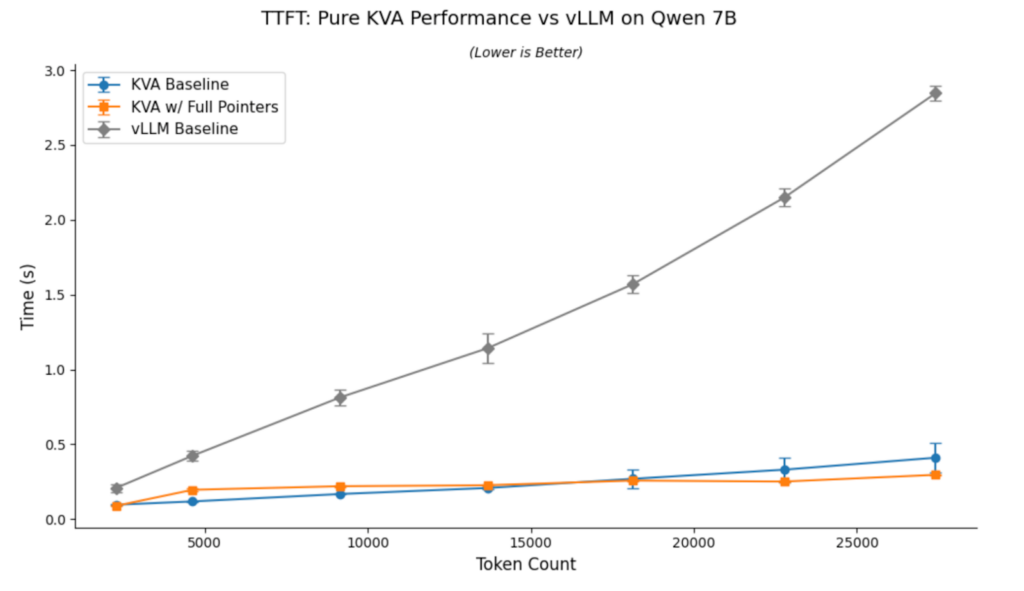
Figure 1: Performance of Pure KVA with granular-prompt caching, KVA baseline, and vLLM on time to first token.
How It Builds on Pure KVA
In our earlier post, “Breaking Enterprise AI Bottlenecks: 20X Faster Inference with the First KV Cache for S3 and NFS,” we introduced how Pure KVA makes LLM state persistence practical across enterprise-grade environments. This innovation enables organizations to reuse entire attention states stored on Everpure® FlashBlade®, cutting latency by up to 20X and reducing GPU cost dramatically.
Granular-prompt caching is the natural evolution of that idea. It extends Pure KVA intelligence from simple reuse to granular optimization.
While the original Pure KVA is about remembering what the model already knows, this new version is about flexibility. It focuses on maximizing reuse between sessions, conversations, or documents, rather than demanding a perfect match every time. Together, they form a complete memory optimization stack that makes large-scale inference both faster and economically sustainable.
The Business Value: Do More with the GPUs You Already Own
For technology executives, the economics of granular-prompt caching are as compelling as the engineering.
- Faster time to insight for complex workflows: By processing only the “delta” of a prompt, applications like financial modeling or legal discovery run drastically faster. In these scenarios, the core context remains static while the queries change, making them perfect candidates for this optimization.
- Lower total cost of ownership (TCO): In real-world deployments, efficient partial reuse translates to savings of hundreds of thousands of dollars per cluster. You effectively expand your GPU capacity to handle more iterations per second without adding a single card.
- Simplified scaling and operations: This feature is fully transparent. There is no application refactoring, no prompt tagging, and no complex caching logic required. It simply works. Because it is built on the proven architecture of Pure KVA, it inherits the same reliability, observability, and multi-backend support across NFS, S3, and GPUDirect Storage.
- Future-proofing RAG pipelines: As retrieval-augmented generation (RAG) and agentic workflows become the standard for enterprise AI, prompts are becoming longer and more dynamic. Granular-prompt caching ensures your infrastructure keeps pace with these evolving workloads without requiring proportional hardware investments.
Built for Scalable AI
Technically, granular-prompt caching is designed for high-performance parallelism and modularity. The real breakthrough lies in how it manages data: by using lightweight metadata pointers instead of duplicating massive tensor files.
At a high level, the system automatically:
- Generates metadata pointers: It creates granular “checkpoints” (for example, 0-2k, 0-4k) for every prompt processed. Because these are just pointers, they consume negligible storage compared to the actual cached data, giving you massive flexibility without the storage bloat.
- Injects sub-prompts: The system identifies the longest matching pointer for a new request and loads it instantly, ensuring the model never has to “re-learn” what it already knows.
- Processes deltas only: It limits GPU computation strictly to the new tokens added at the end of the prompt.
- Leverages Everpure FlashBlade: It utilizes ultra-fast parallel reads to fetch pointer metadata and tensor files without latency penalties.
This approach adds a new layer of agility to the established reliability of Pure KVA. You get the flexibility to iterate on prompts without the storage penalty, all backed by a system already proven in rigorous multi-GPU and multi-node environments.
Caching Is the New Standard
As enterprise adoption of AI shifts from prototype to production, efficiency defines who leads and who lags. Caching for LLM inference is no longer optional but rather a critical requirement for operating at scale.
With this innovation, Everpure continues its mission to eliminate the hidden inefficiencies in AI infrastructure. We’re unlocking new levels of performance, scalability, and cost-effectiveness for the world’s most demanding workloads.
Granular-prompt caching establishes a simple but powerful rule for infrastructure: never rebuild what you can reuse. After all, the smartest infrastructure doesn’t just run fast. It knows the difference between a new problem and one that’s already been solved.
Broaden Your KVA Performance Strategy
See how the original Pure Key-Value Accelerator delivers up to 20x faster inference and lays the foundation for granular-prompt caching in real-world environments.