Summary
While the cloud provides elastic AI infrastructure, it can come at a significant cost as AI scales. By architecting for portability from day one, organizations gain the agility they need to adapt as AI evolves.


Cloud-first AI Makes Sense… Until It Doesn’t
Picture this: Your company’s new AI-powered customer service agent just saved 40% on support costs in its first quarter. The board is thrilled. Your team built it on cloud infrastructure, spinning up GPU clusters in minutes, fine-tuning various LLMs, and deploying inference endpoints with a few clicks.
Then the CFO calls an urgent meeting. The projected annual cloud bill for scaling this to all cloud infrastructure regions globally? $2.4 million. Just for compute.
This scenario plays out in organizations everywhere. The cloud’s promise of elastic AI infrastructure collides with the reality of production economics. But here’s what separates strategic technology leaders from those caught in the cost spiral: starting cloud projects the right way with built-in flexibility to relocate workloads from cloud to on-prem environments easily from day one, whether to reduce costs, meet compliance, or handle scale. All without disrupting teams or operations.
Every successful enterprise AI initiative starts in the cloud for good reasons:
- Zero-friction experimentation: Provision H100 GPUs in minutes, not months
- Access to cutting-edge services: Leverage pre-built LLM APIs, vector databases, and AI pipelines
- Fail fast, pivot faster: Test multiple approaches without infrastructure commitments
- Focus on value, not plumbing: Let cloud providers handle the GPU driver updates
- No wasted capacity: Avoid overprovisioning expensive GPU infrastructure for workloads you only use 1% of the time
Take that customer service agent from our opening scenario. During development, the cloud’s elasticity was essential. The team couldn’t predict whether they’d need 10 or 100 GPUs for inferencing until they started processing real customer interactions. But once the model worked and forecasts showed millions of monthly interactions, it became clear that keeping inferencing in the cloud would be prohibitively expensive.
But here’s where forward-thinking CTOs make a crucial decision. Instead of building directly on proprietary cloud services, they architect for portability using Portworx®. This isn’t about avoiding the cloud or moving completely away from it; it’s about preserving optionality and using resources wisely.
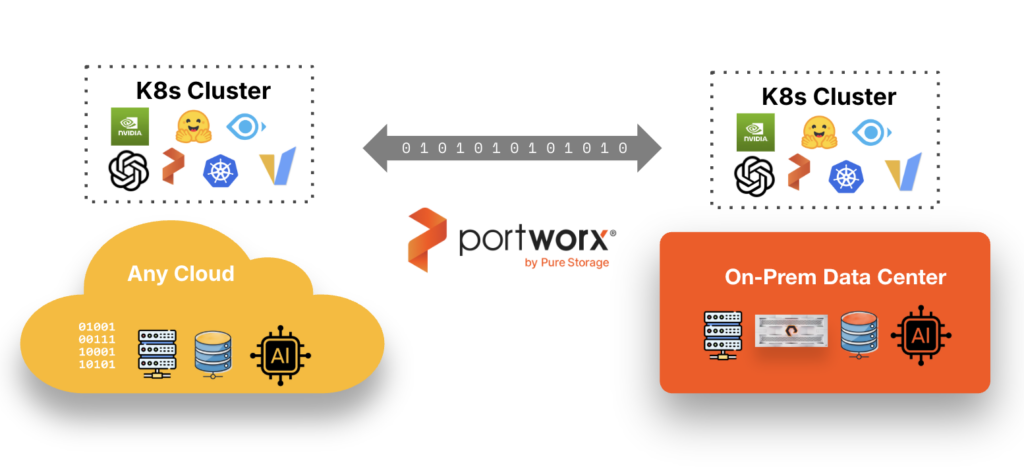
Figure 1: Portworx allows customers to migrate seamlessly between on-premises and cloud environments via Kubernetes orchestration.
The Smart Play: Build for Flexibility from Day One
The smart play is recognizing that different workloads have different economic profiles. Your development team might need cloud resources for rapid experimentation, while your production inference workloads run more cost-effectively on premises. During peak usage like Black Friday for retail, holiday travel for airlines, or unexpected viral moments, you need the ability to burst into the cloud seamlessly. It’s about having the flexibility to place workloads where they make the most economic and operational sense, without re-architecting your entire stack.
Why does this matter? Because when your proof of concept succeeds (and that customer service agent starts processing millions of requests), you’ll face predictable challenges:
| Workload | Annual Cloud Cost | On-Prem Cost (Three-Year TCO) |
|---|---|---|
| 32 x H100 GPUs (24 x 7 Inference) | $2,400,000-$3,200,000 | $1,200,000-$1,600,000 |
| 50TB Monthly Data Egress | $50,000 | $0 |
| AI Experimentation Stack | $800,000+ | $400,000 |
| Total Annual Spend | ~$3.2M-$4M | ~$1.6M-$2M |
The math becomes even more compelling when you factor in data gravity. As your AI generates terabytes of interaction logs, embeddings, and model artifacts, your cloud storage, compute costs, and egress fees compound rapidly.
Three Phases to AI Infrastructure Maturity
Smart organizations don’t wait for sticker shock. They build hybrid-ready from the start, creating an architecture that can fluidly move between environments:
Phase 1: Cloud-native Development (Months 0-6)
In this phase, the focus is speed and experimentation. Development teams want to stand up infrastructure in hours, not weeks, and adapt quickly as models evolve.
- Rapid prototyping on cloud GPU instances
- Kubernetes-based orchestration
- Container-first architecture
Portworx ensures early data portability by providing persistent, container-native storage that isn’t tied to a specific cloud platform.
Phase 2: Hybrid Production (Months 6-18)
Here, cost efficiency becomes the driver. The architecture adapts to a hybrid model, placing workloads where they’re most economical without disrupting development workflows.
- Production inference shifts on-prem
- Cloud retained for burst and dev workloads
- 50-70% cost savings with equal agility
Portworx enables seamless migration of the stateful components of your workloads (like model data, indexes, logs, etc.), which are often the most difficult to move across environments.
Phase 3: Optimized Operations (18+ Months)
By this stage, your AI infrastructure operates like a flexible, cost-aware system. It is smart enough to shift as business needs or compute costs change.
- Core AI runs on dedicated infrastructure
- Cloud supports experimentation and overflow
- Full compliance, sovereignty, and control
Portworx supports intelligent workload placement by keeping critical data close to compute, maintaining performance, and simplifying data governance across environments.
The Crucial Role of Portworx
Across all three phases, Portworx is the platform that makes hybrid AI architecture possible without compromise. It acts as a foundational control layer, ensuring your data and applications stay fluid, portable, and resilient, regardless of where workloads run. While compute workloads themselves can be containerized and orchestrated with Kubernetes tools, Portworx provides the persistent data layer that allows those workloads to move without re-platforming or risk of data loss.
Portworx provides:
- One-click migration: Move your entire AI stack, including models, data, and configurations, between cloud and on-prem with zero application changes
- Cloud burst capability: Seamlessly scale to cloud during peak demand without re-architecting
- Kubernetes-native: Works identically on EKS, GKE, AKS, or your on-prem OpenShift cluster
- Data locality intelligence: Keeps frequently accessed data close to compute, critical for LLM performance
- Quality of service controls: Prioritize storage performance for high-throughput AI jobs and prevent resource contention across teams
- End-to-end encryption: Protect sensitive data sets in transit and at rest, maintaining enterprise-grade security across environments
For AI workloads specifically, Portworx handles the complexities that typically derail migrations by providing:
- Consistent GPU scheduling across environments
- Stateful set management for distributed training
- Automatic volume replication for model versioning
- Native integration with frameworks like PyTorch, TensorFlow, and Ray
In short, Portworx bridges innovation and operational discipline, letting you scale AI initiatives without falling into infrastructure traps or cloud lock-in.
Real-world Example: Fortune 500 Retailer’s AI Journey
A major retailer started its recommendation engine project on AWS, using SageMaker for initial experiments. By building on Kubernetes with Portworx from day one, the company:
- Developed and validated its models in three months using cloud resources
- Migrated to on-premises infrastructure in two weeks (not months)
- Reduced annual infrastructure costs from $2.1M to $650K
- Maintained the ability to burst to cloud during Black Friday
- Achieved 99.99% uptime with active-active failover
The Executive Takeaway
As AI transitions from experiment to enterprise capability, infrastructure strategy becomes a board-level discussion. CTOs who start with the end in mind of building cloud-native but platform-agnostic infrastructure position their organizations for both innovation speed and operational efficiency.
The question isn’t whether you’ll need to optimize cloud costs. It’s whether you’ll have the architectural flexibility to do so when the time comes. With Portworx, you can have your cloud cake and eat it too: Start fast in the cloud, scale smart with hybrid, and maintain the agility to adapt as AI technology evolves.
Don’t let your AI success story become a cautionary tale about cloud costs. Build for portability from day one, and keep your options—and your budget—open.
The World’s Most Powerful Data Storage Platform for AI
Unleash the full power of your GPUs, with a purpose-built storage solution engineered for AI, at any scale.